TIMELINE
Mar - Aug 2025
Institution
Willpower
TEAM
Designer, Product Manager, Engineer, Sales
ROLE
Product Designer
INTRO
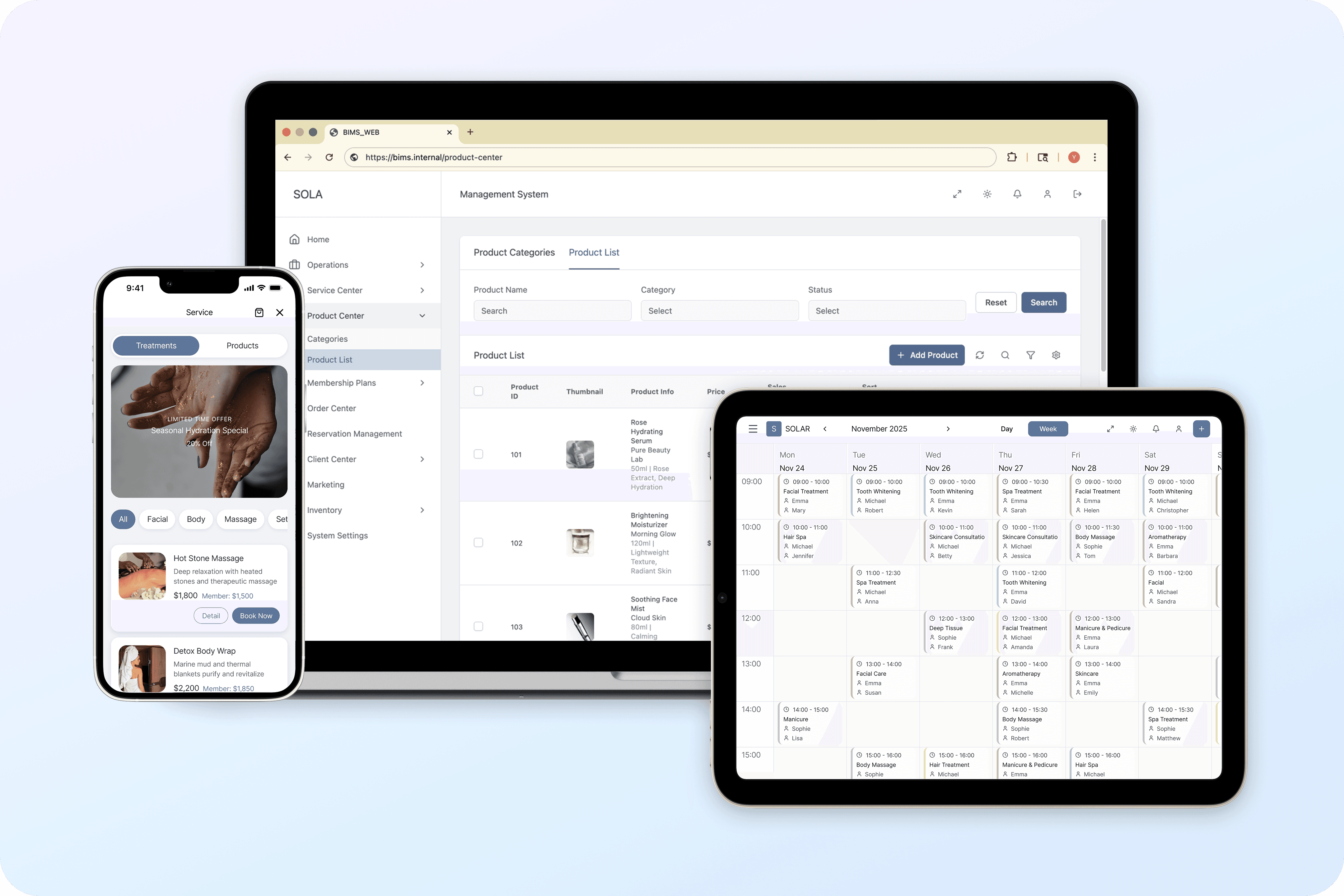
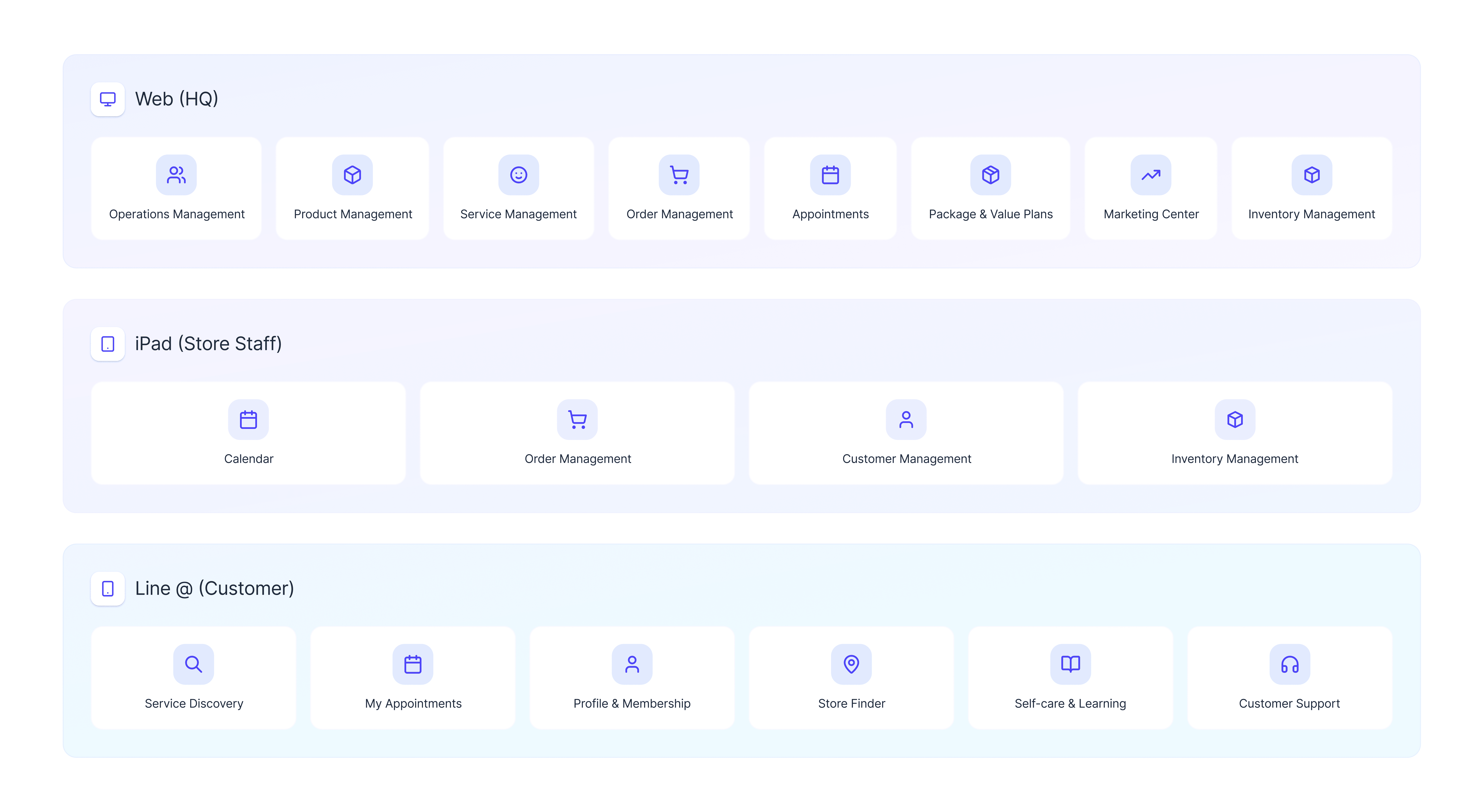
Designed a unified beauty clinic ecosystem to centralize operations across all locations. We connected HQ (Web), Store Staff (iPad App), and Customers (LINE@ Interface) to streamline the end-to-end service journey. The system integrates CRM and POS functions, ensuring seamless communication and data synchronization among all stakeholders.
KEY CONTRIBUTION
Mixed-Method User Research
User Flows & Information Architecture
Figma Prototyping
Usability Testing & Iteration
INTRODUCTION
Building a unified CRM ecosystem for a multi-store beauty brand.
I led the end-to-end design connecting HQ, Stores, and Customers. By transforming manual operations into a synchronized digital system, we helped the brand move from fragmented paperwork to a data-driven service experience.
BUSINESS GOAL
Cut Operational Costs
Reduce manual work and communication gaps between Head Office and local stores.
Drive Revenue Growth
Increase total earnings by utilizing customer data to build better loyalty programs.
Boost Customer Retention
Turn one-time visitors into loyal members by smoothing out the booking and service experience.
PROBLEM STATEMENT
1
Operational Chaos
Manual price updates relied on local store managers to execute, resulting in high error rate.
> 35% inconsistency across stores
2
Friction in Checkout & Signup
Legacy processes couldn't handle hybrid payments, causing delays and slow onboarding.
> Long wait times at checkout
3
Blind Spots
Customer data was trapped in isolated store systems. HQ lacked a centralized view and remarketing.
> Unable to retain members
RESEARCH
Step 1: User Research
To understand the real needs of cat owners, we moved beyond simple assumptions. We used a mixed method approach that combined broad quantitative data with deep qualitative observations. This strategy helped us identify the specific emotional and functional gaps in current pet technology.
Stakeholder Interviews (HQ)
5 Key Stakeholders
Defined business goals and identified the "blind spots" in current data collection

Competitor Analysis (iPad POS)
5+ leading iPad POS apps
Compared service workflow on different system
Contextual Inquiry (In-Store)
1 Store Locations
Shadowed store managers and staff to observe booking and checkout process

Step 2: Synthesis & Patterns
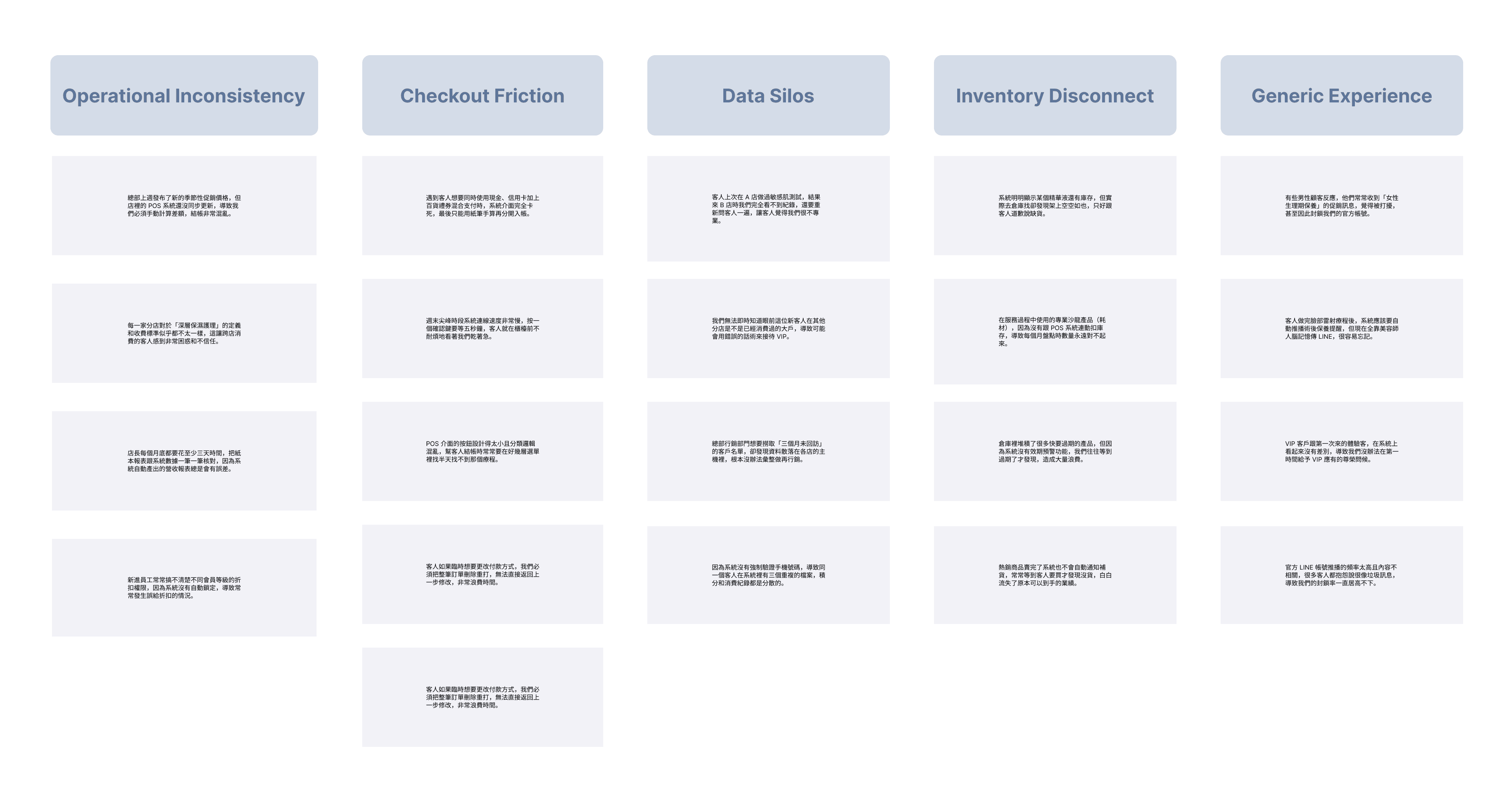
After gathering raw data, I used affinity mapping to cluster scattered observations into actionable insights. I categorized them into 5 Key Themes, which directly informed our feature roadmap.
This process helped us pivot from "fixing the old system" to "building a new ecosystem."
Step 3: Final Personas
DESIGN GOAL
How might we create a unified ecosystem that centralizes HQ control while empowering store staff to deliver personalized experiences?
STRATEGY & IDEATION
Design Principle
Unified System Logic
Centralized all rules at HQ so price and service updates sync instantly to Store iPads and Customer Apps, eliminating manual errors and inconsistency.
Data-Driven Retention
Evolved beyond simple points by implementing a 4-tier RFM model (Recency, Frequency, Monetary) to identify and retain high-value VIP users.
Seamless Service Loop
Connected the online booking directly to the offline in-store service. This ensures staff have all customer details and payment preferences ready before the client even walks in.
The Ecosystem Architecture
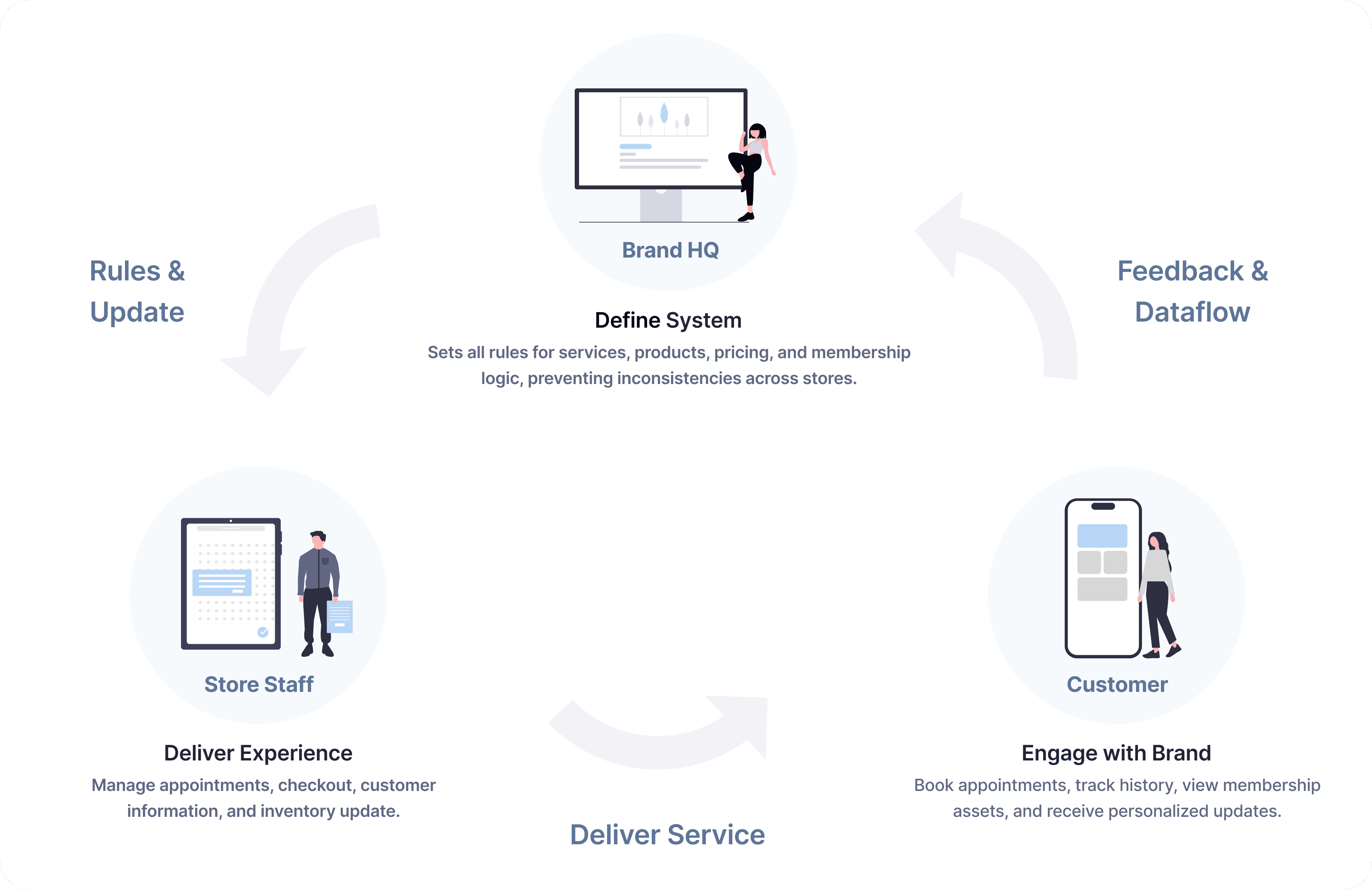
High-Level Architecture
FINAL SOLUTION
Product #1
We designed the HQ Web platform to replace scattered spreadsheets with a unified dashboard. It allows corporate teams to define brand rules once and instantly sync them to over 50 stores, ensuring everyone stays on the same page.

1
Centralized Service Management
We built a unified catalog system where HQ can edit service details and pricing in a single modal.
With one click on "Publish," updates are instantly synchronized to all store iPads, ensuring 100% pricing consistency and zero manual errors.
2
Defining Retention Strategy (Membership Logic)
HQ can configure membership rules in a visual control panel instead of relying on manual policy documents.
By adjusting spending thresholds and defining rewards for different tiers (Silver/Gold/Diamond), the system automatically applies these rules to every transaction.
Product #2
The Service Engine: Empowering Frontline Staff
The iPad app helps staff focus on the customer rather than back-office tasks. By combining appointment management, CRM, and checkout into one mobile interface, we turned a fragmented workflow into a smooth service experience.

1
Personalized Service & Clienteling
Staff now have a 360° view of the customer to deliver better care. They can quickly select skin conditions, upload photos, and add consultation notes.
A one-tap "Care Message" instantly connects the in-store service with online engagement.
2
Frictionless Hybrid Checkout
The interface simplifies hybrid payments without complex math. Staff can easily combine prepaid sessions, coupons, store value, and cash in a single transaction.
This automation speeds up the process and reduces queue wait times during peak hours.
Product #3
The Personal Concierge: Always-On Engagement
We embedded the experience directly into LINE to remove the barrier of downloading a new app. This creates a lightweight, always-available concierge that makes engaging with the brand as easy as chatting with a friend.
1
Effortless Booking & Re-booking
Users can book or reschedule appointments in seconds directly through the menu.
This self-service model offers 24/7 convenience for customers and significantly reduces admin work for the front desk.

2
O2O Commerce (Click & Collect)
We designed a seamless flow for users to browse products and schedule in-store pickup.
This captures purchase intent instantly, turning the service-based app into a revenue driver.
3
Transparent Loyalty & Assets
The profile gives users real-time access to their membership tier, points, and remaining sessions.
Visualizing this value builds trust and encourages them to return to use their assets.
REFLECTION
From Designing Screens to Orchestrating Services This project was a pivot from designing standalone interfaces to orchestrating a living ecosystem. The challenge wasn't just UI; it was defining how three different user roles (HQ, Staff, Customer) interact within a shared data environment.
I learned that in an O2O system, "Logic is the invisible interface." Every design decision—from a button click on an iPad to a push notification on LINE—had to be designed with a deep understanding of data flow and operational context. Managing this complexity sharpened my ability to balance technical constraints with service experience, ensuring that digital efficiency never compromised the human touch of beauty services.
KEY LEARNING
01. Systemic problems require systemic solutions I learned that surface-level symptoms (e.g., "slow checkout") often stem from deep-rooted structural issues (e.g., "disconnected data"). As a Senior PD/PM, my value lies in combining qualitative observations with quantitative data to map the entire service blueprint, identifying and fixing the root causes rather than just patching the UI.
02. The Product Manager as a "Behavior Architect" True digital transformation isn't just about delivering features; it's about shifting behavior. By designing a system that rewards staff for accurate data entry and empowers customers with self-service tools, I learned how to use product mechanics to align user incentives with business goals.
03. Data structure defines design possibilities This project reinforced that effective design cannot exist in a vacuum. Timely alignment with engineering on data structure (Schema) and API capabilities is crucial. I learned that understanding the "backend logic" early allows us to design more robust, scalable front-end experiences and prevents costly rework later.