TIMELINE
Mar - Aug 2025
COMPANY
Willpower
TEAM
Designer, Product Manager, Engineer, Sales
ROLE
Product Designer
KEY CONTRIBUTION
Mixed-Method User Research
User Flows & Information Architecture
Figma Prototyping
Usability Testing & Iteration
The Context
A beauty chain.
50+ stores with
3 disconnected stakeholders
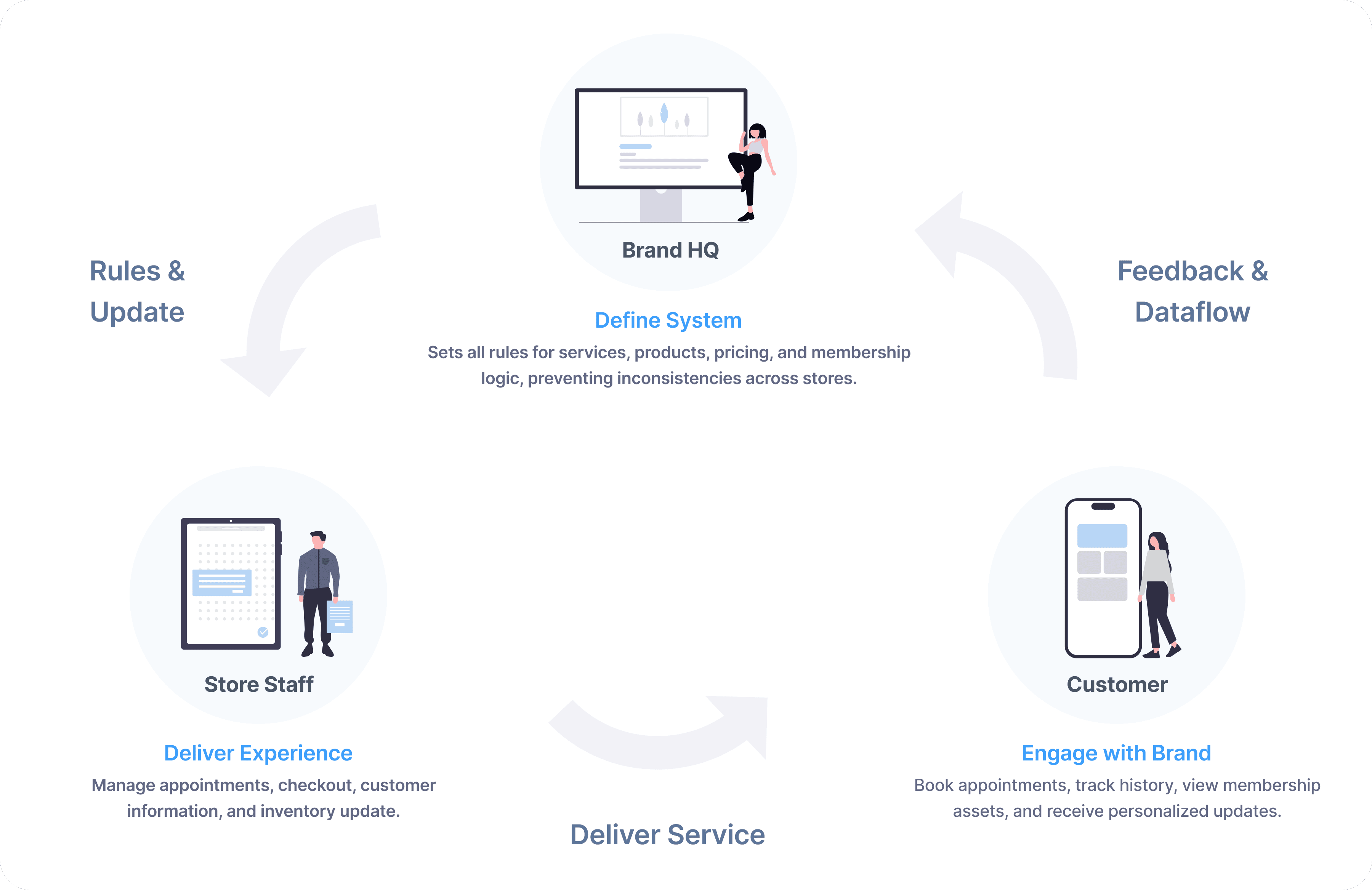
At Willpower, I was brought in as the product designer and PM for a beauty chain expanding across 50+ locations. The challenge wasn't just designing screens. It was untangling three completely separate operational worlds that had never talked to each other.
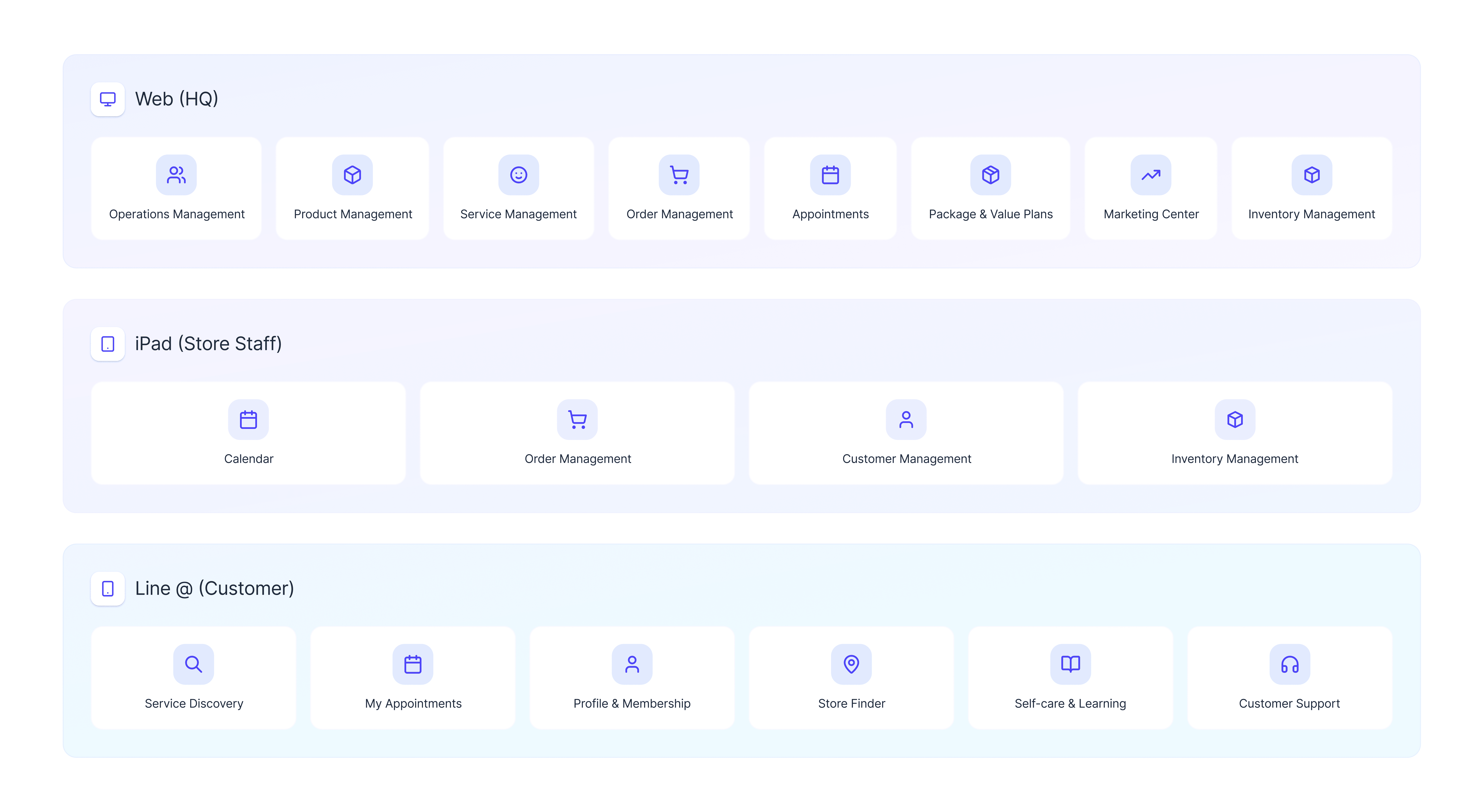
Brand HQ managed the business from a desktop web system. Store staff ran daily operations on iPad. Customers interacted through LINE on mobile. Every group had their own workflow, their own tools, and when something went wrong, there was no way to trace it across the chain.
Store Staff
Brand HQ
Customer
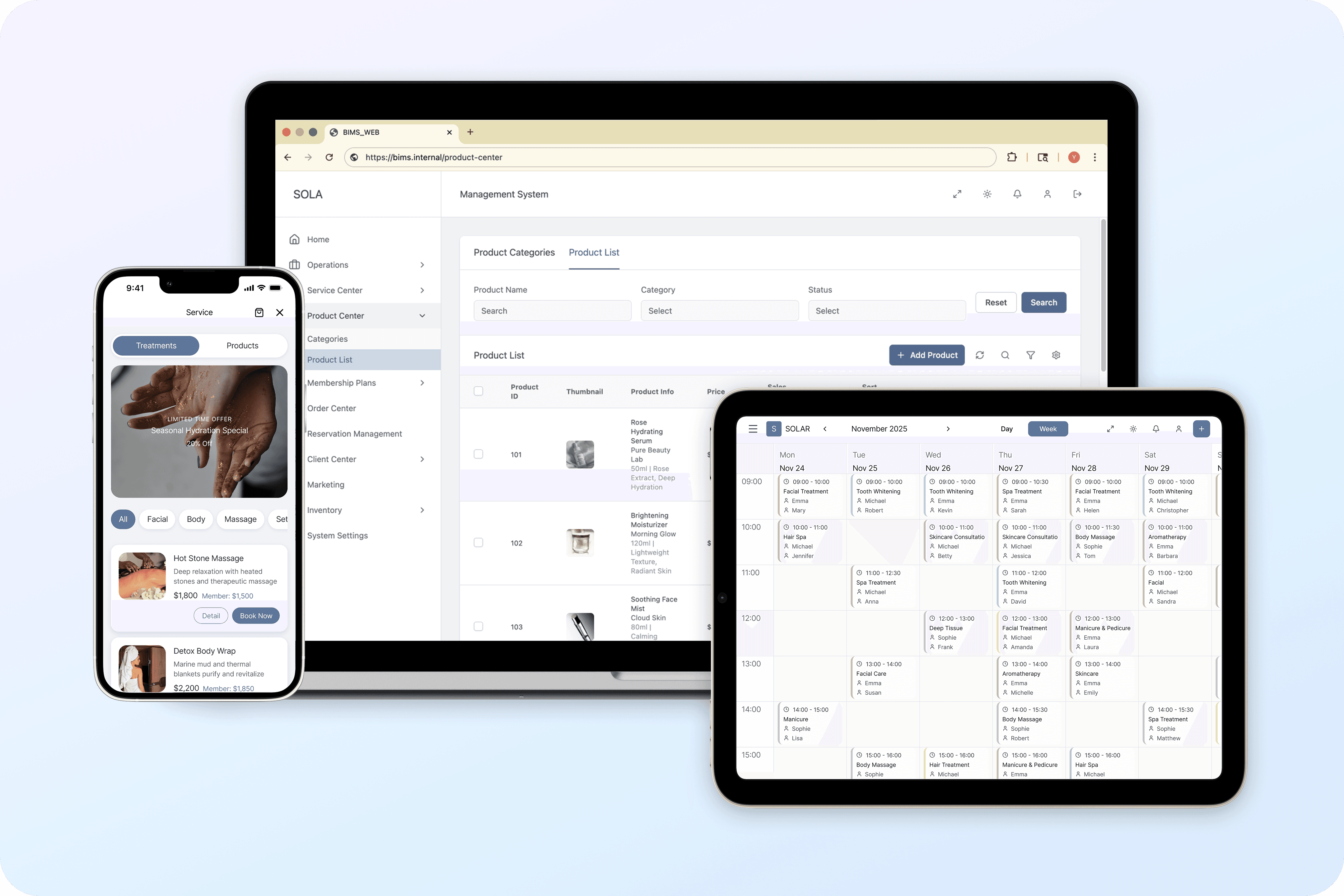
Final Deliverable
Three Stakeholders. Three platforms. One connected system.
The Problem
The old system didn't just underperform. It eroded trust across every team.
Head Quarter (HQ)
"We push updates from HQ, but we never know if the stores actually follow them."
"A customer wants to pay three ways and I have to figure it out myself, in front of them."
Store Staff
Customer
"I went to a different location and they had no idea who I was."
RESEARCH
We went in-store before we touched Figma.
Before proposing any solutions, we needed to understand how each team actually worked — not how they said they worked. I ran contextual inquiries at a store location, interviewed 5 HQ stakeholders, and benchmarked 5 competing iPad POS systems.
Stakeholder Interviews (HQ)
5 Key Stakeholders
Defined business goals and identified the "blind spots" in current data collection

Competitor Analysis (iPad POS)
5+ leading iPad POS apps
Compared service workflow on different system
Contextual Inquiry (In-Store)
1 Store Locations
Shadowed store managers and staff to observe booking and checkout process

KEy FINDings
Every team stopped trusting the system they were working in

Insight 1
Operational Inconsistency
HQ pushed pricing updates, but the POS never synced. Staff calculated differences by hand and hoped for the best. Store managers spent three days every month reconciling paper records against a system they couldn't trust.

Insight 2
Checkout Friction
The system had no support for mixed payments. Staff had to split transactions manually and determine on the spot whether a customer was a member to apply the right pricing. One checkout required multiple judgment calls, with no system guardrails to catch mistakes.

Insight 3
Data Silos
A returning customer at Store B was a complete stranger to the system. Staff had no record of their history, their skin treatments, or whether they were a VIP. For customers who traveled or moved, visiting a different location meant starting over completely.

Insight 4
Generic Experience
Post-treatment follow-ups depended on individual staff remembering to send a message. Customers who had just done a facial got pushed content completely unrelated to their service, and gradually stopped engaging.
DESIGN GOAL
One question became our north star.
How might we create a unified ecosystem that centralizes Head Quarter control while empowering store staff to deliver personalized experiences?
STRATEGY & IDEATION
Control and visibility became our design foundation.
Unified System Logic
Centralized all rules at HQ so price and service updates sync instantly to Store iPads and Customer Apps, eliminating manual errors and inconsistency.
Data-Driven Retention
Evolved beyond simple points by implementing a 4-tier RFM model (Recency, Frequency, Monetary) to identify and retain high-value VIP users.
Seamless Service Loop
Connected the online booking directly to the offline in-store service. This ensures staff have all customer details and payment preferences ready before the client even walks in.
How the three platforms connect
What each platform owns (High-Level Information Architecture)
FINAL SOLUTION
Product #1
We designed the HQ Web platform to replace scattered spreadsheets with a unified dashboard. It allows corporate teams to define brand rules once and instantly sync them to over 50 stores, ensuring everyone stays on the same page.

1
Centralized Service Management
We built a unified catalog system where HQ can edit service details and pricing in a single modal.
With one click on "Publish," updates are instantly synchronized to all store iPads, ensuring 100% pricing consistency and zero manual errors.
2
Defining Retention Strategy (Membership Logic)
HQ can configure membership rules in a visual control panel instead of relying on manual policy documents.
By adjusting spending thresholds and defining rewards for different tiers (Silver/Gold/Diamond), the system automatically applies these rules to every transaction.
Product #2
The Service Engine: Empowering Frontline Staff
The iPad app helps staff focus on the customer rather than back-office tasks. By combining appointment management, CRM, and checkout into one mobile interface, we turned a fragmented workflow into a smooth service experience.

1
Personalized Service & Clienteling
Staff now have a 360° view of the customer to deliver better care. They can quickly select skin conditions, upload photos, and add consultation notes.
A one-tap "Care Message" instantly connects the in-store service with online engagement.
2
Frictionless Hybrid Checkout
The interface simplifies hybrid payments without complex math. Staff can easily combine prepaid sessions, coupons, store value, and cash in a single transaction.
This automation speeds up the process and reduces queue wait times during peak hours.
Product #3
The Personal Concierge: Always-On Engagement
We embedded the experience directly into LINE to remove the barrier of downloading a new app. This creates a lightweight, always-available concierge that makes engaging with the brand as easy as chatting with a friend.
1
Effortless Booking & Re-booking
Users can book or reschedule appointments in seconds directly through the menu.
This self-service model offers 24/7 convenience for customers and significantly reduces admin work for the front desk.

2
O2O Commerce (Click & Collect)
We designed a seamless flow for users to browse products and schedule in-store pickup.
This captures purchase intent instantly, turning the service-based app into a revenue driver.
3
Transparent Loyalty & Assets
The profile gives users real-time access to their membership tier, points, and remaining sessions.
Visualizing this value builds trust and encourages them to return to use their assets.
REFLECTION
From Designing Screens to Orchestrating Services This project was a pivot from designing standalone interfaces to orchestrating a living ecosystem. The challenge wasn't just UI; it was defining how three different user roles (HQ, Staff, Customer) interact within a shared data environment.
I learned that in an O2O system, "Logic is the invisible interface." Every design decision—from a button click on an iPad to a push notification on LINE—had to be designed with a deep understanding of data flow and operational context. Managing this complexity sharpened my ability to balance technical constraints with service experience, ensuring that digital efficiency never compromised the human touch of beauty services.
KEY LEARNING
01. Systemic problems require systemic solutions I learned that surface-level symptoms (e.g., "slow checkout") often stem from deep-rooted structural issues (e.g., "disconnected data"). As a Senior PD/PM, my value lies in combining qualitative observations with quantitative data to map the entire service blueprint, identifying and fixing the root causes rather than just patching the UI.
02. The Product Manager as a "Behavior Architect" True digital transformation isn't just about delivering features; it's about shifting behavior. By designing a system that rewards staff for accurate data entry and empowers customers with self-service tools, I learned how to use product mechanics to align user incentives with business goals.
03. Data structure defines design possibilities This project reinforced that effective design cannot exist in a vacuum. Timely alignment with engineering on data structure (Schema) and API capabilities is crucial. I learned that understanding the "backend logic" early allows us to design more robust, scalable front-end experiences and prevents costly rework later.