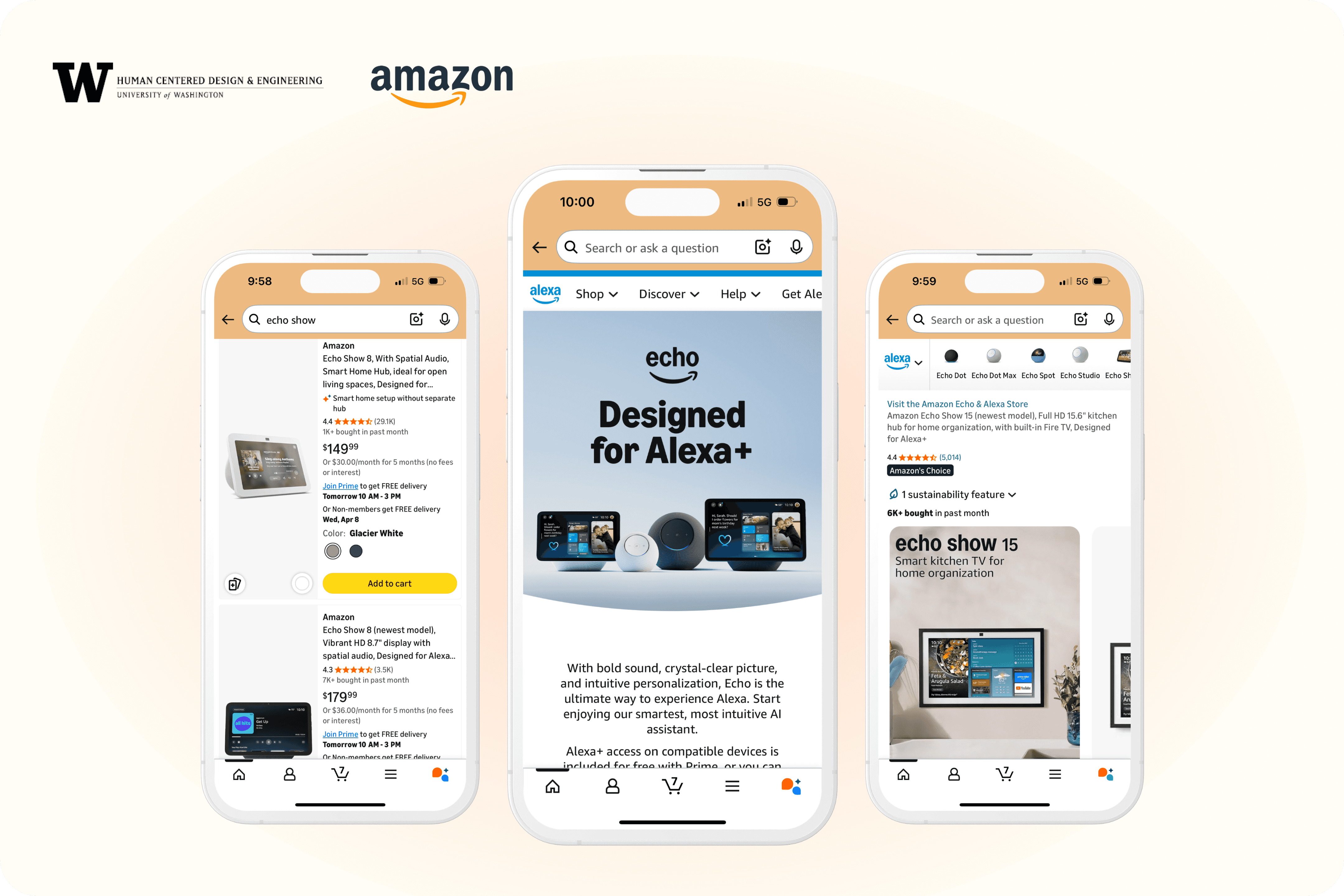
Designed and executed usability studies to evaluate product discovery and feature comprehension of Echo Show devices on the Amazon mobile app. Synthesized qualitative and quantitative data to uncover user mental model misalignments, providing actionable recommendations on UI architecture and badge systems to enhance feature discoverability for the new Alexa+ service.
TIMELINE
Jan - March 2026
Institution
University of Washington, HCDE
Amazon, User Experience Research Team
TEAM
UW HCDE- 3 Designer, 1 Product Manager
Amazon Consumer Devices- User Research & Marketing partners
MY ROLE
UX Researcher, Modertator
OVERVIEW
In Winter 2026, we took Usability Studies course in UW HCDE. We partnered with Amazon's UX Research team to evaluate their mobile shopping experience for Echo Show devices, identifying friction points in product differentiation and feature discoverability. When browsing the Amazon app, users struggle to differentiate between visually similar Echo Show models and frequently overlook or misunderstand the newly introduced "Alexa+" feature. Our goal was to uncover these critical usability barriers and provide actionable solutions to improve the shopping journey.
KEY CONTRIBUTION
Interaction Map Definition
Usability Task/Post-Task Questionnaire/Screener Design
Session Moderation
Data Synthesis & Reporting
Project Timeline Control
OVERVIEW
When shopping on the Amazon mobile app, users typically begin their evaluation on the Search Results Page, relying on limited information to differentiate between visually similar Echo Show models. This study investigates whether the current mobile experience effectively helps users distinguish between these models and accurately comprehend the new Alexa+ feature prior to purchase. To capture an unbiased, first-time buyer perspective, we recruited active Amazon electronics shoppers who are the primary technology decision-makers for their households, specifically excluding current Echo Show owners and industry insiders for the usability studies.
STUDY GOAL
Primary Goal
The primary goal of this study is to evaluate how effectively Amazon's mobile experience supports clear and accurate early-stage understanding of the Echo Show product line during initial browsing.
Key Areas of Evaluation
- How imagery, titles, and badges communicate device differences
- Whether visual UI cues support correct feature inference
- Whether Search Results provide enough information for comparison
- How clearly Alexa+ is explained above the fold
RESEARCH QUESTION
RQ1 — Model Differentiation
How accurately can users differentiate between Echo Show models (5, 5 Kids, 8, 11, 15, and 21) based on search results and initial product detail page exposure?
RQ2 — Alexa+ Discoverability
How effectively do users identify and understand Alexa+ as a feature of Echo Show devices when viewing search results page elements, including images, titles, badges, and brief descriptions?
METHODOLOGY
Date: Feb 19 2026 – Feb 23, 2026
Session: 8
Method: Remote moderated sessions via UserTesting
Test Artifact: High-Fidelity Prototype of Amazon App Search Result Page & Product Detail Page
Method: Moderated Probing: Giving tasks and asking follow-up questions to clarify confusion points and expectations.
Think-Aloud Protocol: Capturing real-time cognitive processes and decision-making.
Goals: Check usability of the methods listed above
PARTICIPANTS
Demographics: Ages 26–50, diverse professions (QA Engineer, Sales, Students, etc.)
Tech Familiarity: Ranged from "Somewhat Familiar" to "Extremely Familiar".
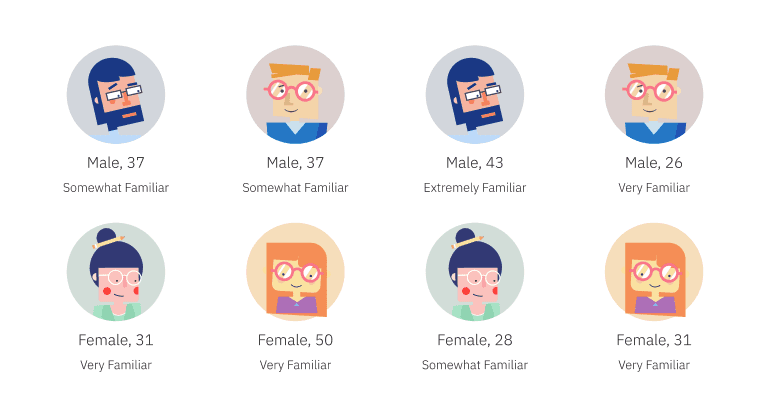
For our participants, we recruited 8 diverse individuals, ranging in age from 26 to 50. As you can see from our demographic breakdown, we had a mix of professions and tech familiarity ranging from 'somewhat familiar' to 'extremely familiar.' we especially screened them to ensure they were the primary tech decision-makers in their households, but intentionally excluded current smart display owners and industry insiders to capture a pure, unbiased first-time buyer experience.
TASK
Our 60-minute sessions were structured around 5 key stages.
Stage #1
Baseline Knowledge
Before showing them the prototype, we simply asked what they already knew about Echo Show and Alexa.
Goal
Establish a baseline to determine if users have legacy mental models or are pure novices.
“What do you know about the Echo Show products?”
“What do you know about Alexa?“
A/B Test
(Images-Only)
A/B Test
(Text-Only)
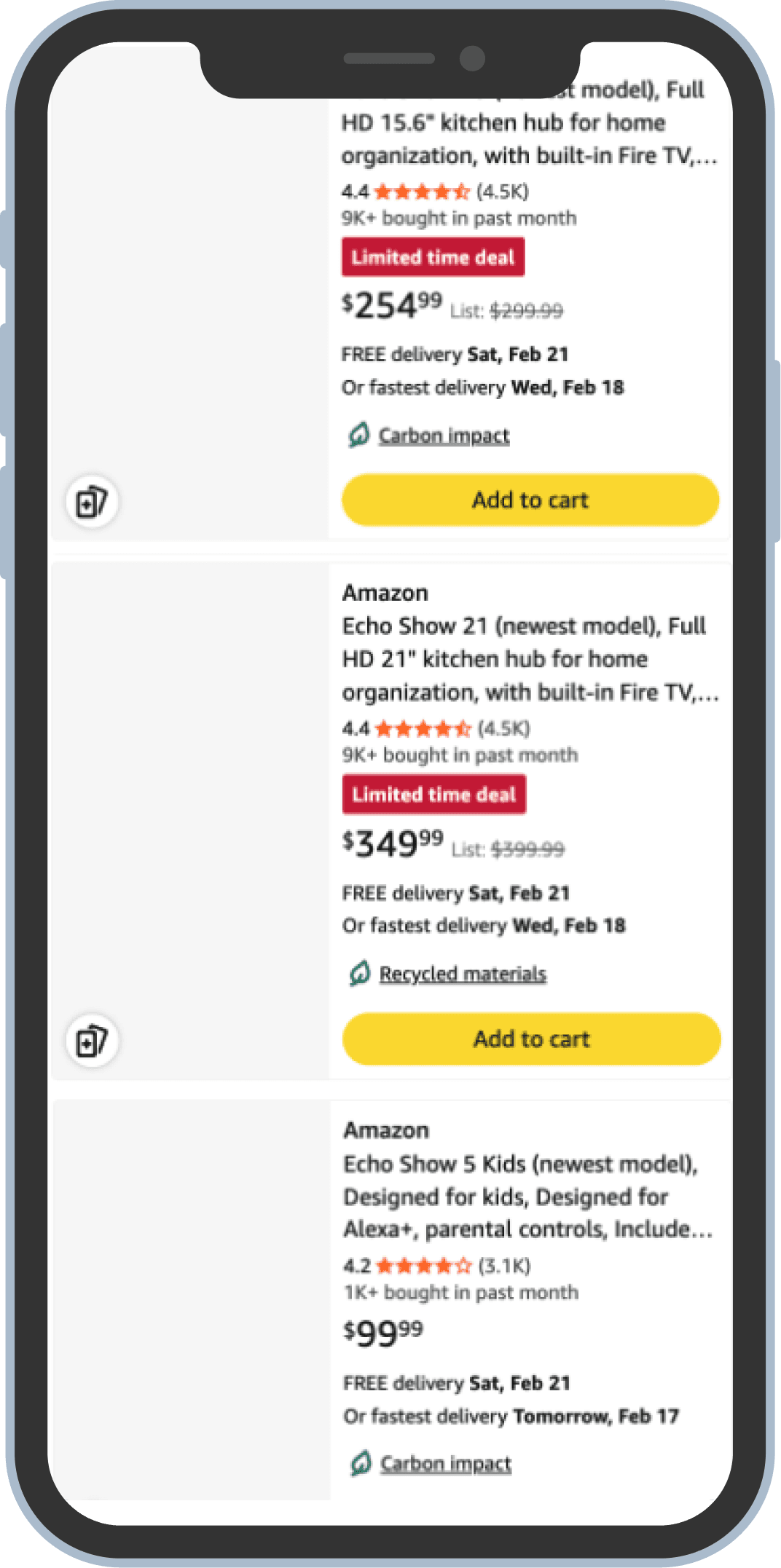
Product
Grouping
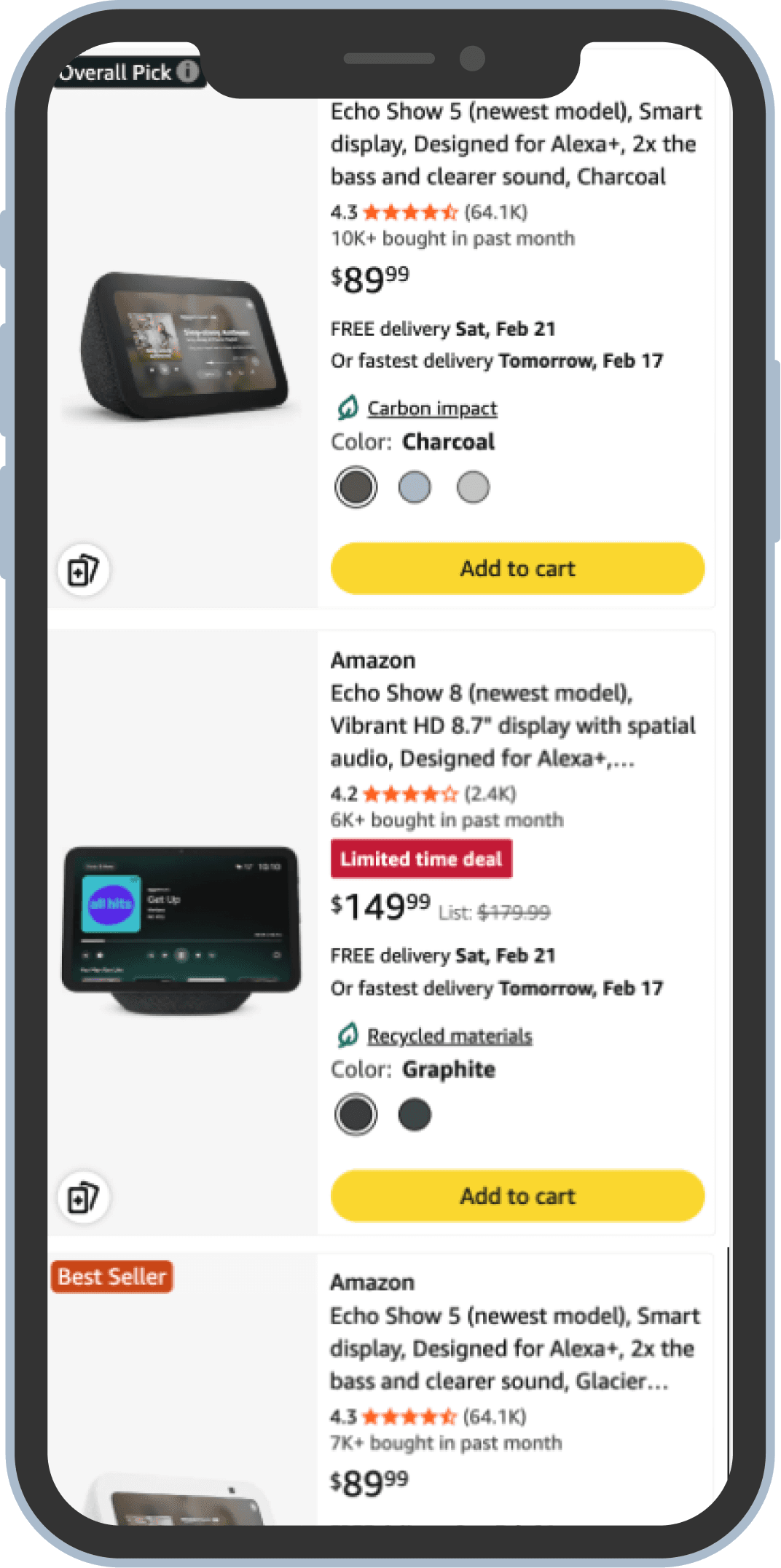
Stage #2
Discoverability & Mental Models (Tasks 1 & 2)
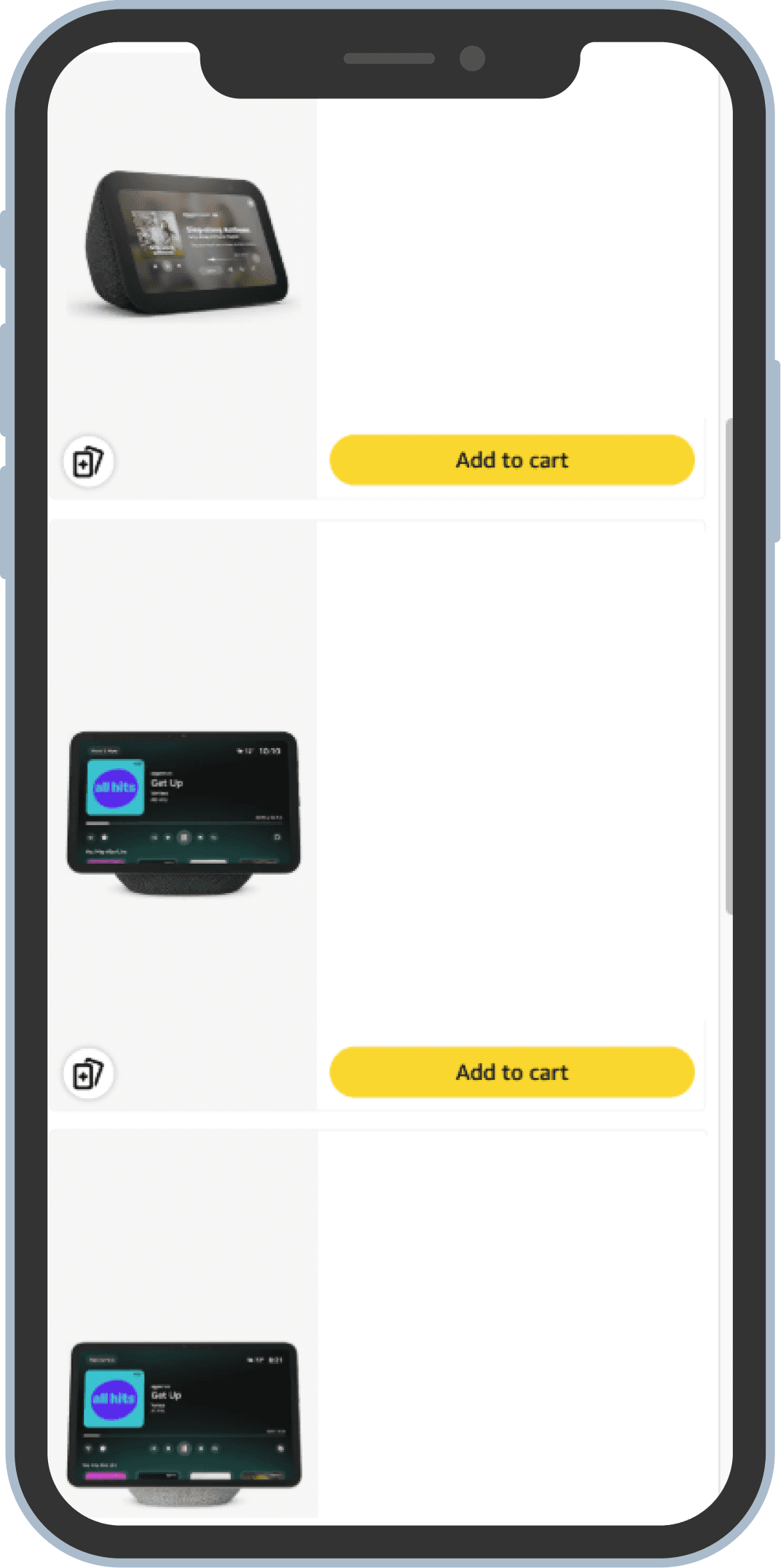
This is where we implemented our A/B test. We showed users either an 'Images-Only' or 'Text-Only' version of the search results page, and then asked them to group the products.
Goal
Identify which cues (visual vs. textual) drive product differentiation and how mental models evolve with more information.
Stage #3
Scenario-Based Shopping (Task 4)
We gave them a specific task: find a smart display for the kitchen with 'Fire TV built-in.'
Goal
Test feature validation and information hierarchy.

Stage #4
Brand & Value Comprehension (Tasks 3 & 5)
We observed whether users noticed the new 'Alexa+' branding as they shopped. Once they did, we asked them to explain it.
Goal
Evaluate the clarity and comprehension of Alexa+ functionality, pricing plans, and subscription conditions.
Stage #5
Post-Test Questionnaire
We used a mix of formats, including Likert-scale questions o measure perceived clarity and difficulty, and multiple-choice questions to identify specific confusion points.
Goal
Quantify user perception of brand clarity, product distinctness, and overall shopping confidence.
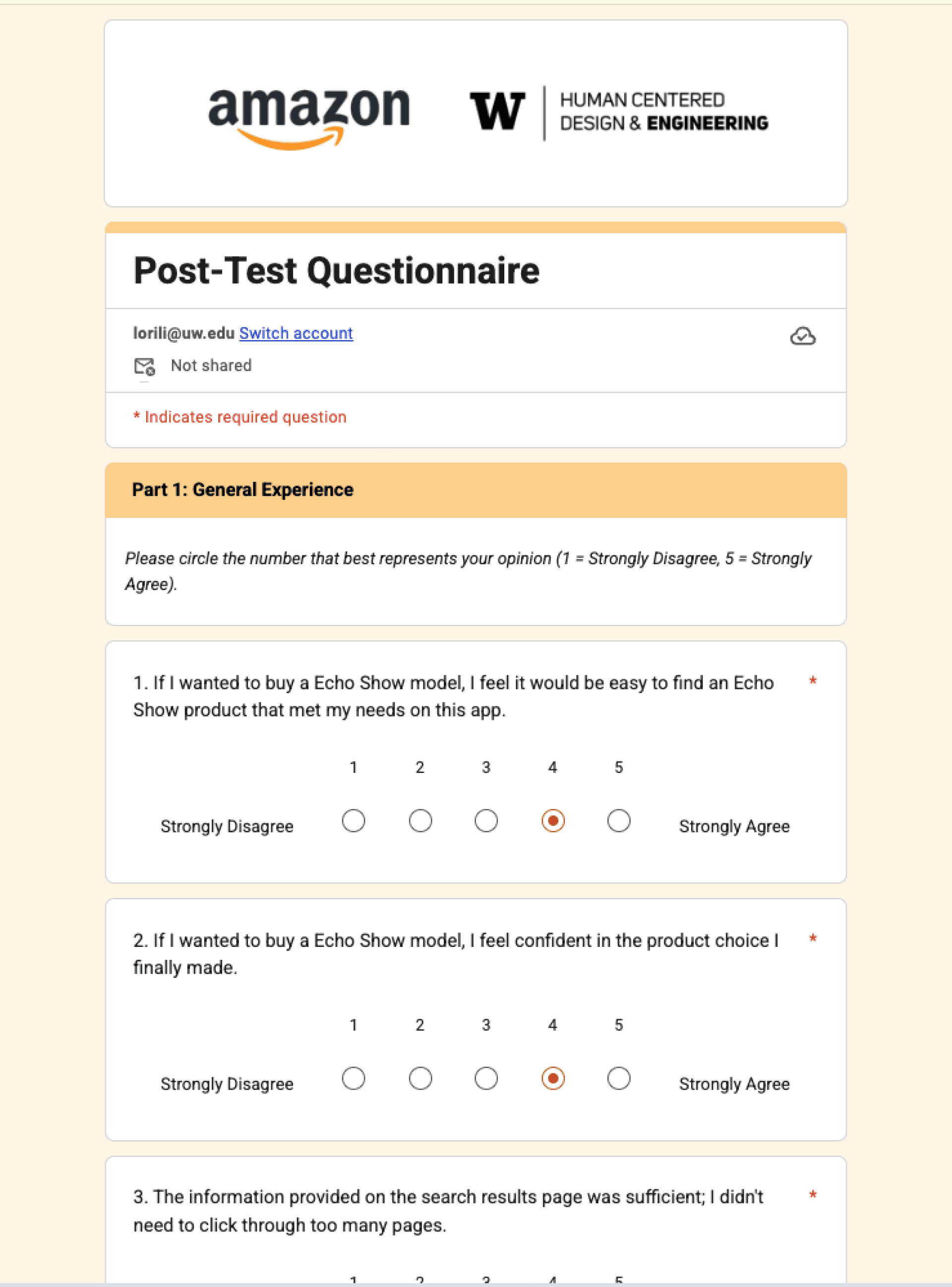
DATA COLLECTION
Our 60-minute sessions were structured around 5 key stages.
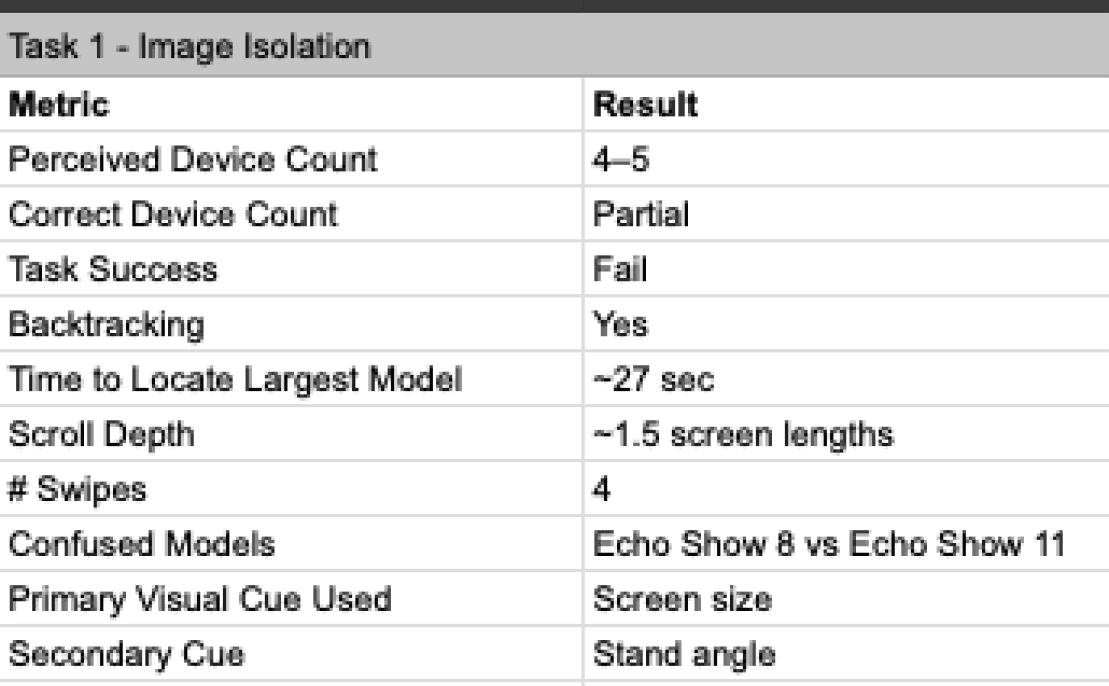
Quantitative Performance Metrics
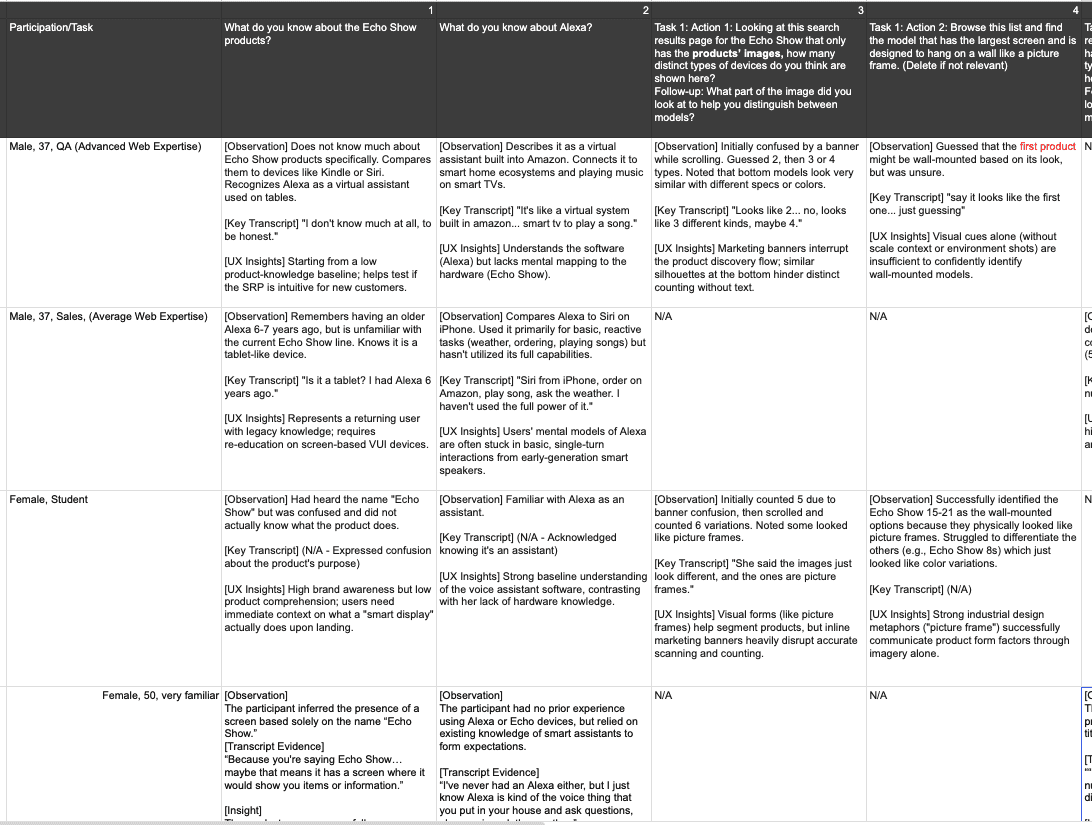
Qualitative Behavioral Insights
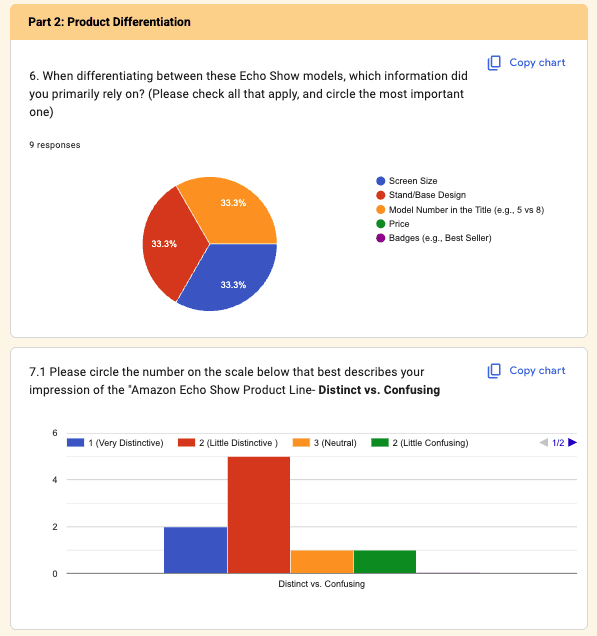
3. Self-Reported Perceptions (Post-Test)
CLASSIFICATION OF USABILITY ISSUES
Severity level 1
prevents completion of a task
Severity level 2
creates significant delay and frustration
Severity level 3
has a minor effect on usability
Severity level 4
subtle problem, points to a future enhancement
Findings- RQ1
Model Differentiation
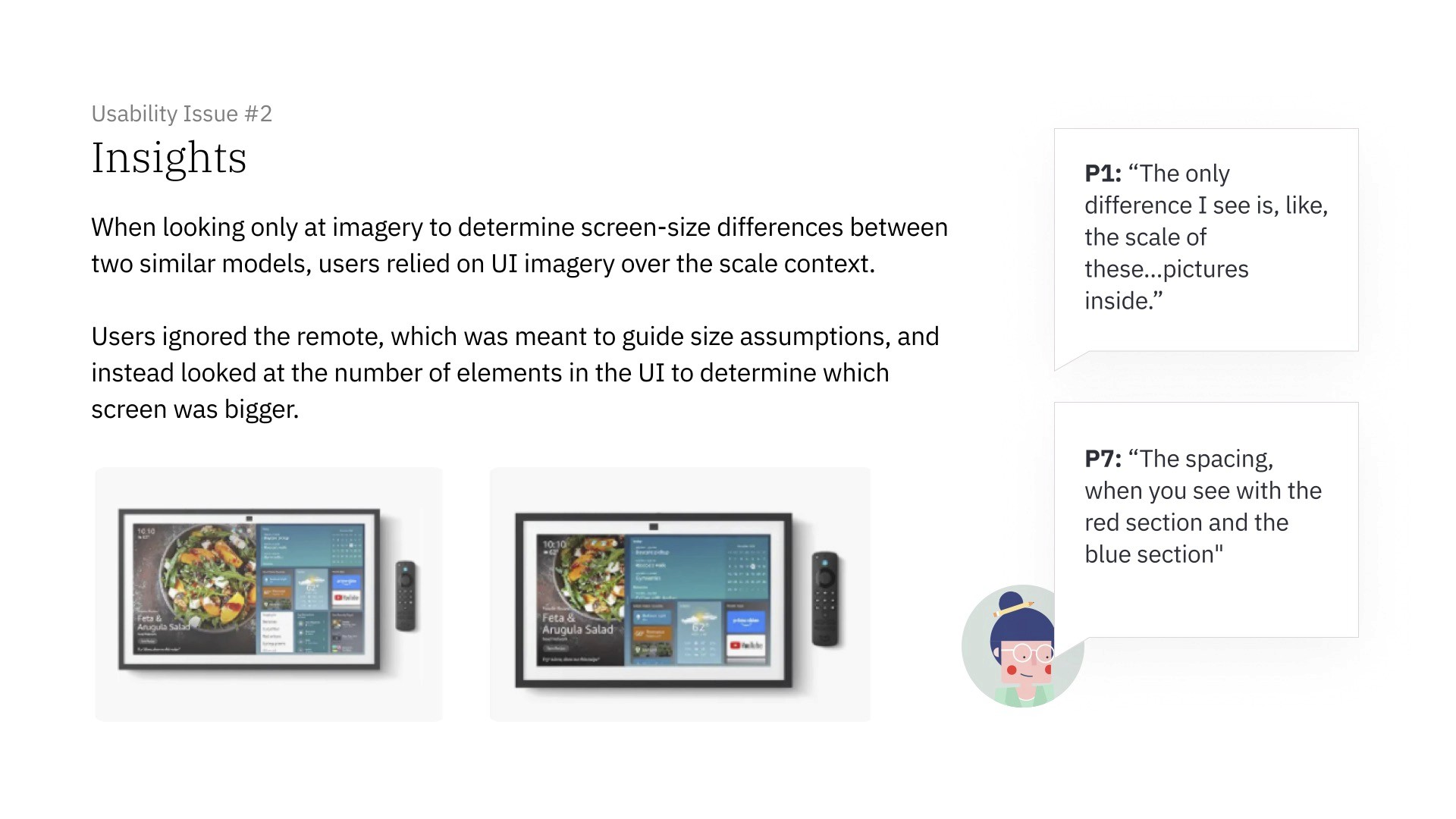
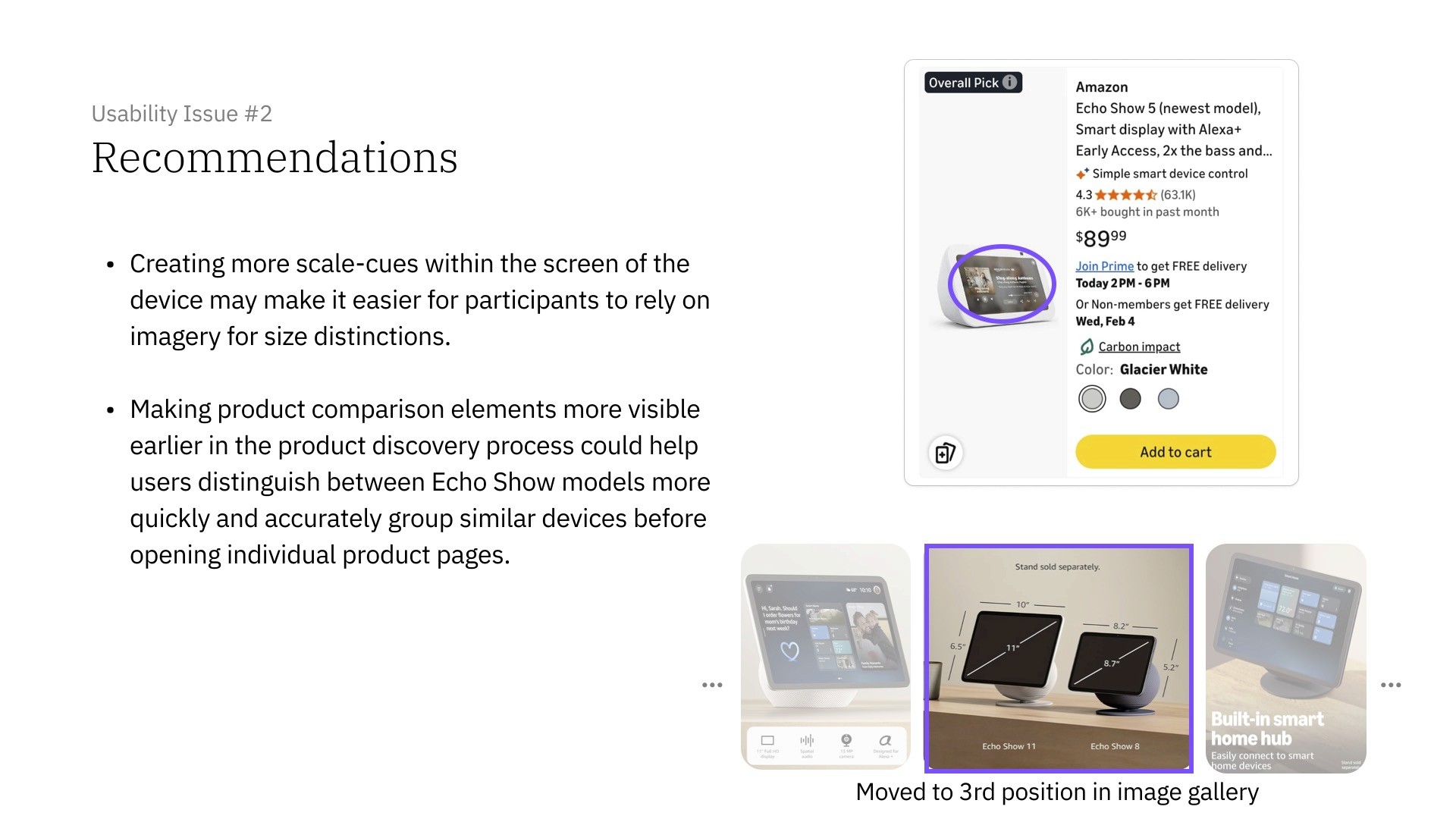
How accurately can users differentiate between Echo Show models (5, 5 Kids, 8, 11, 15, and 21)
based on search results and initial product detail page exposure?
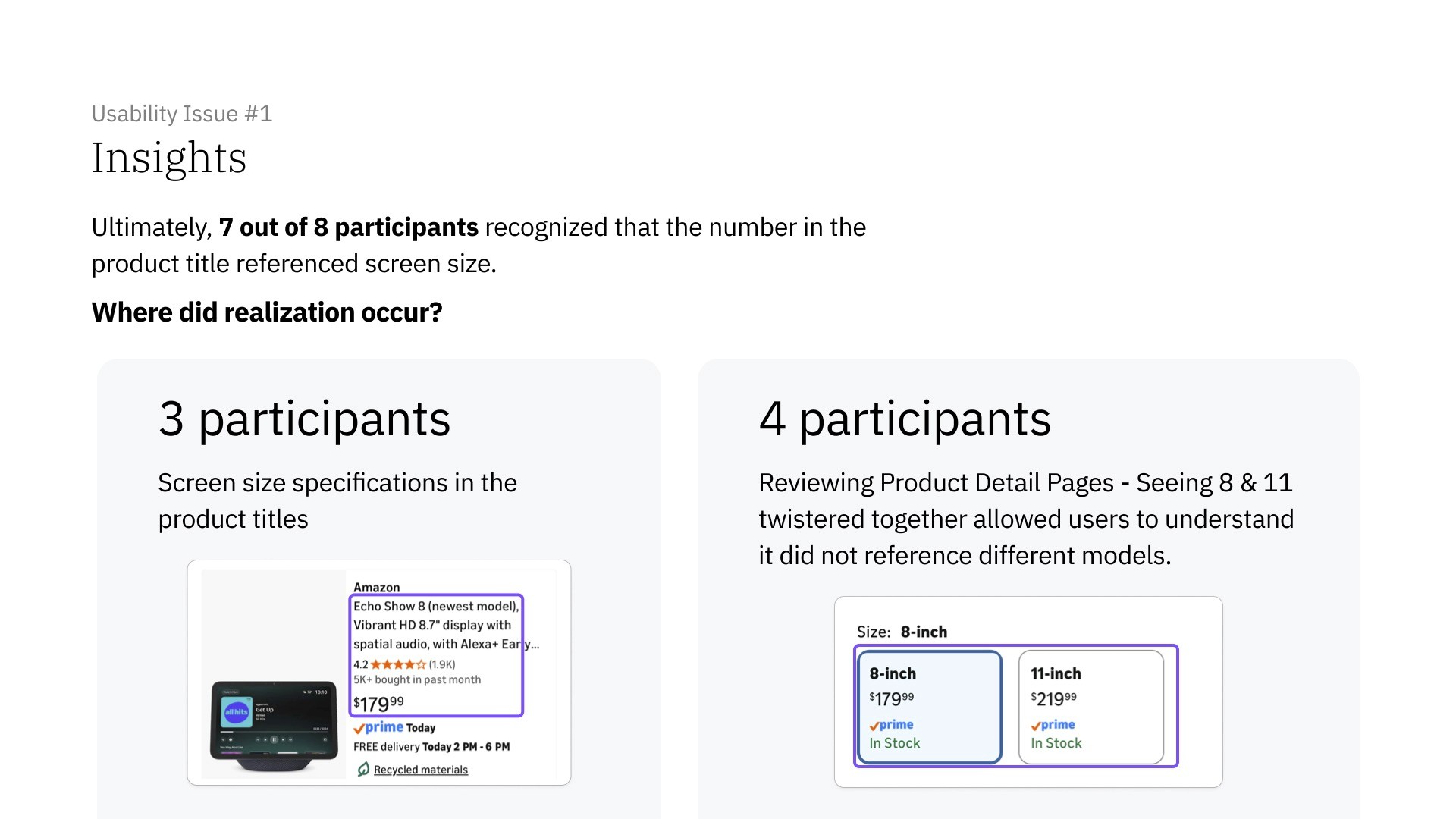
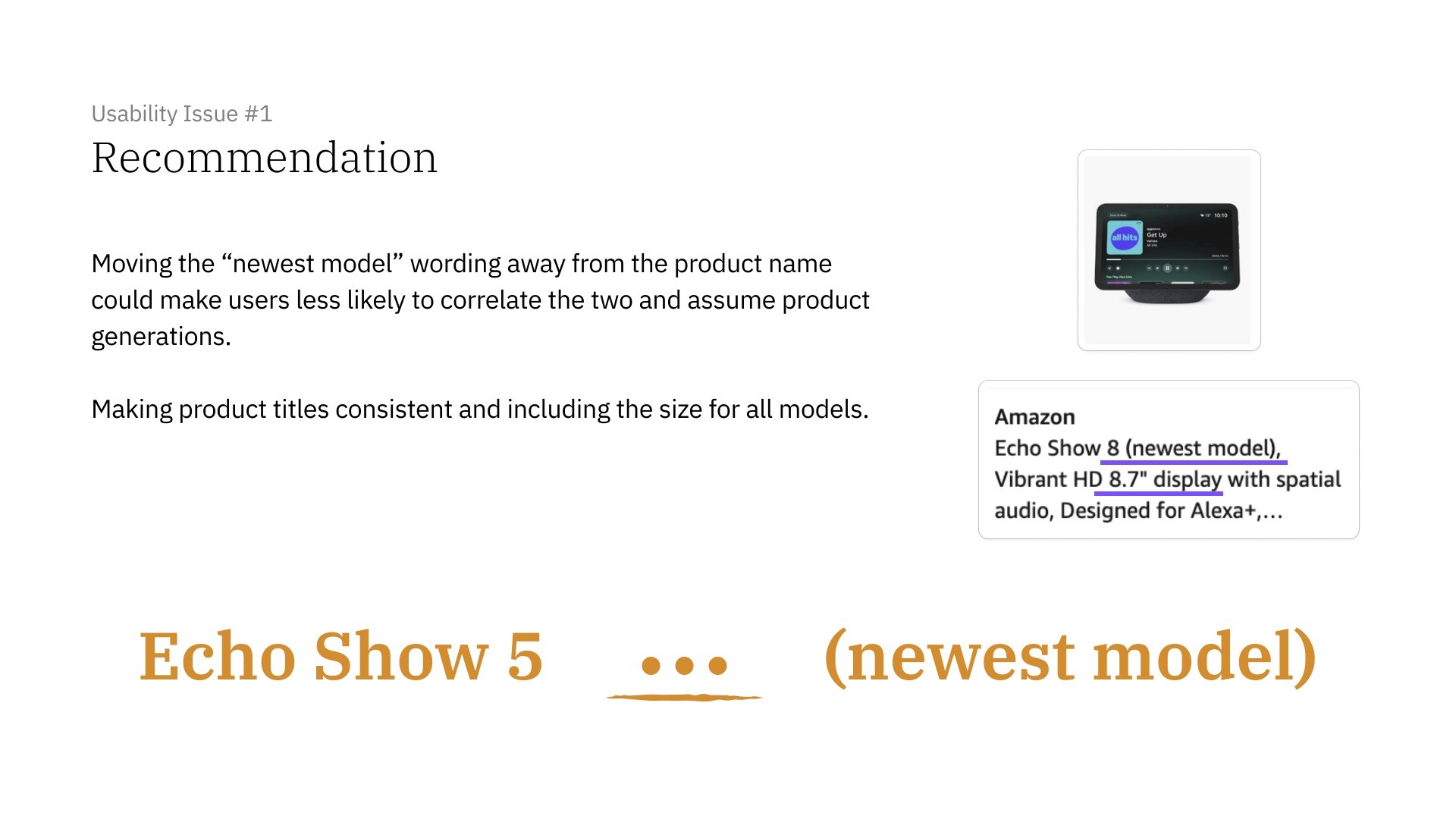
Usability Issue #1
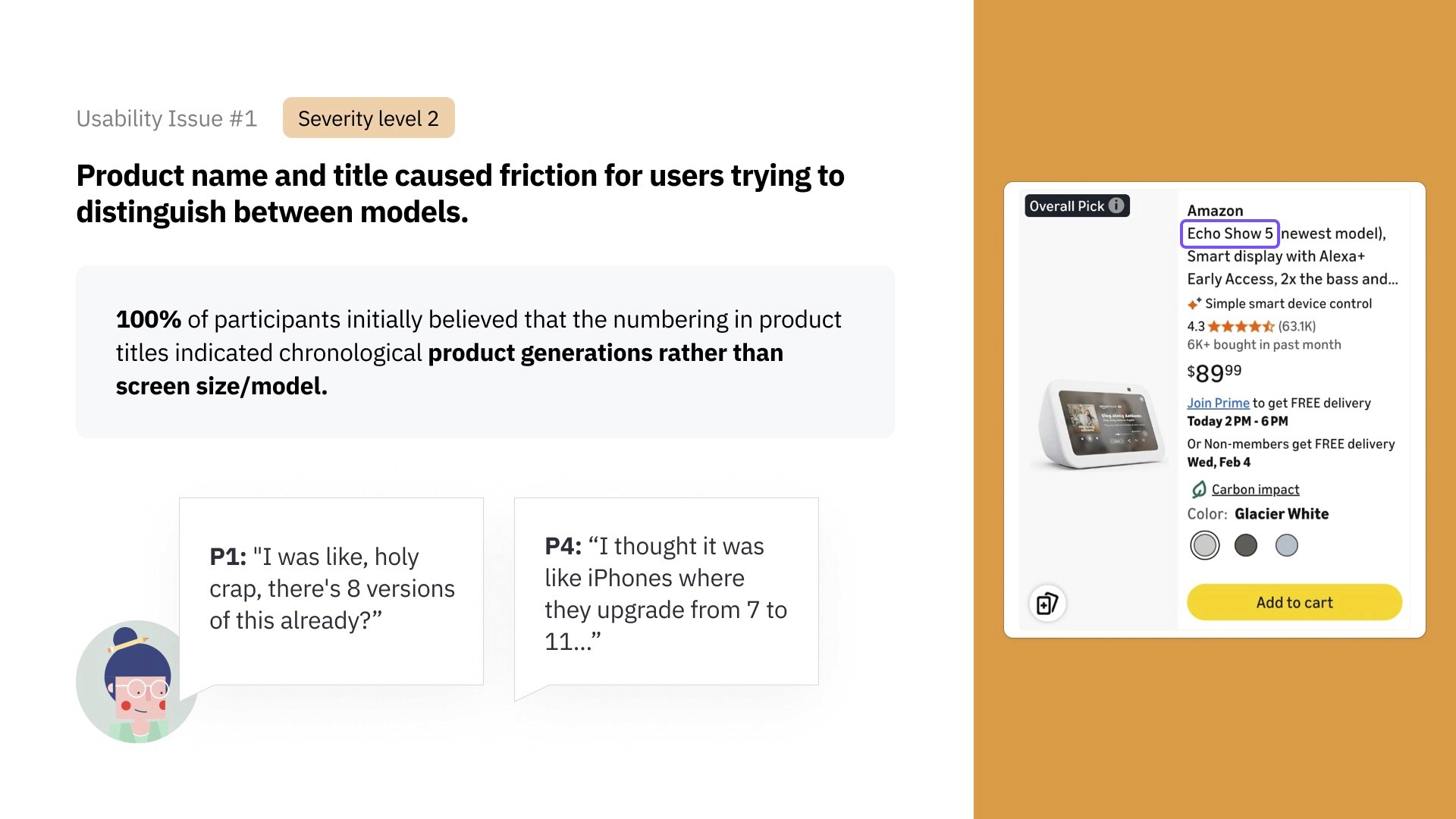
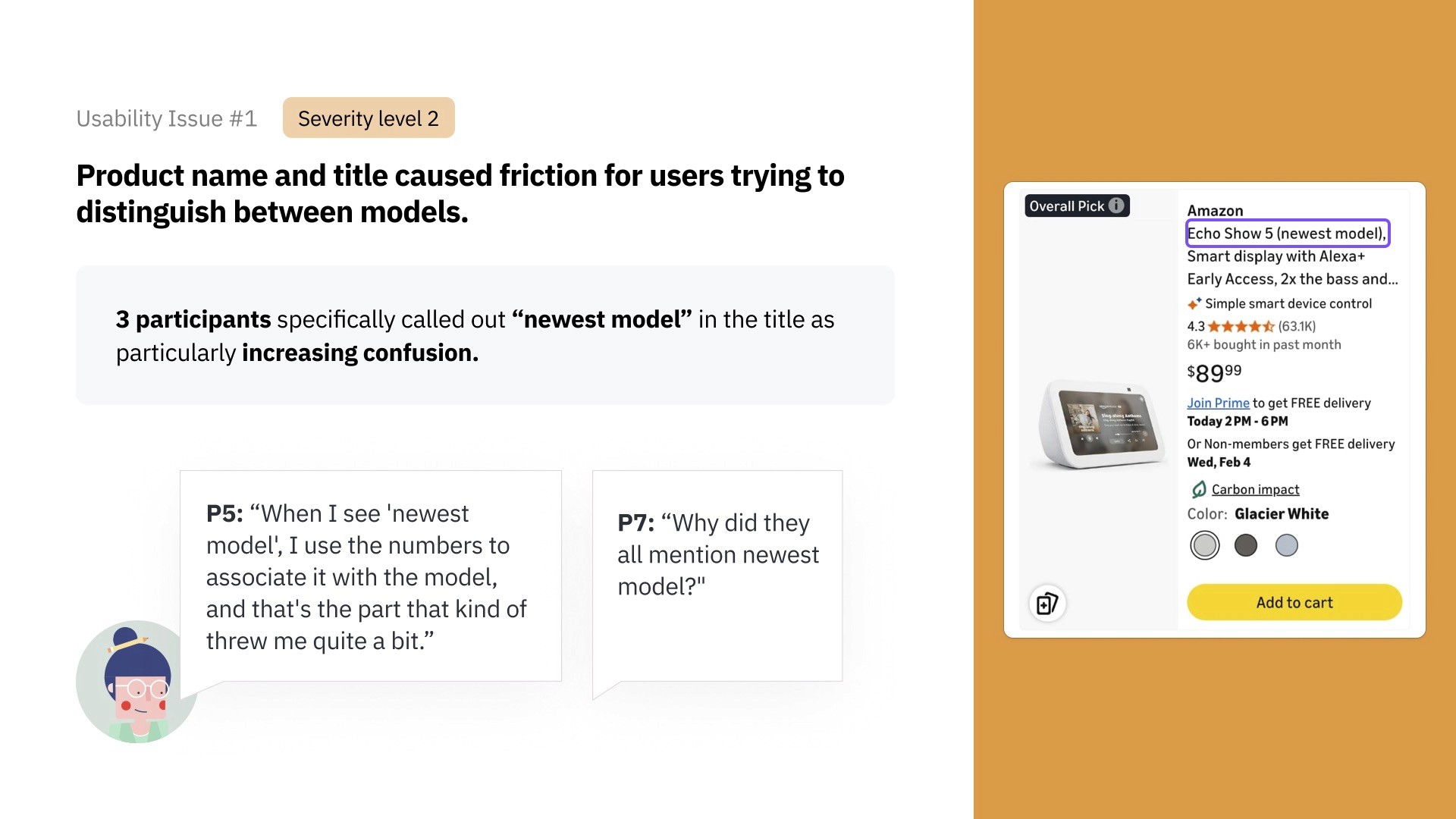
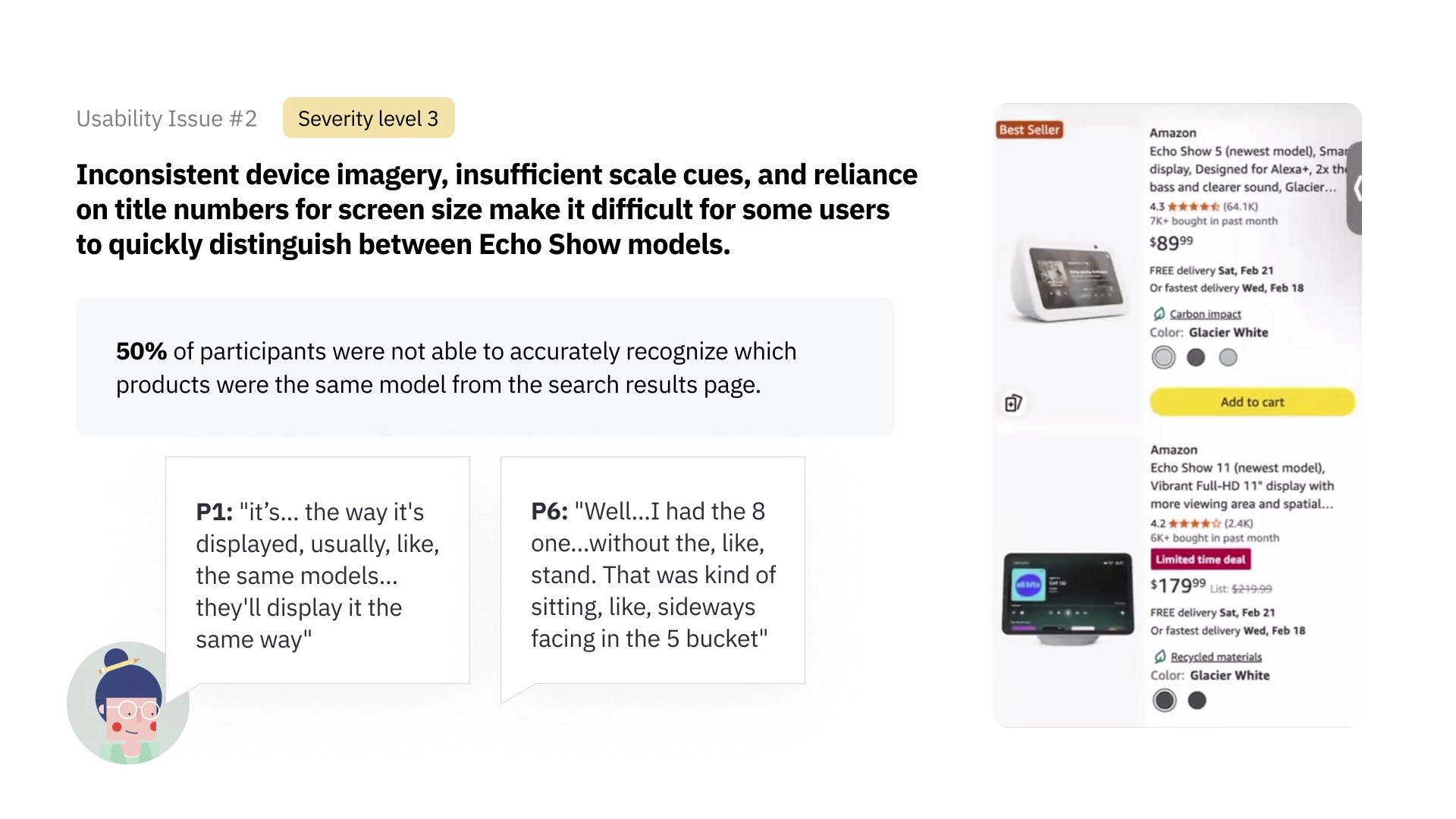
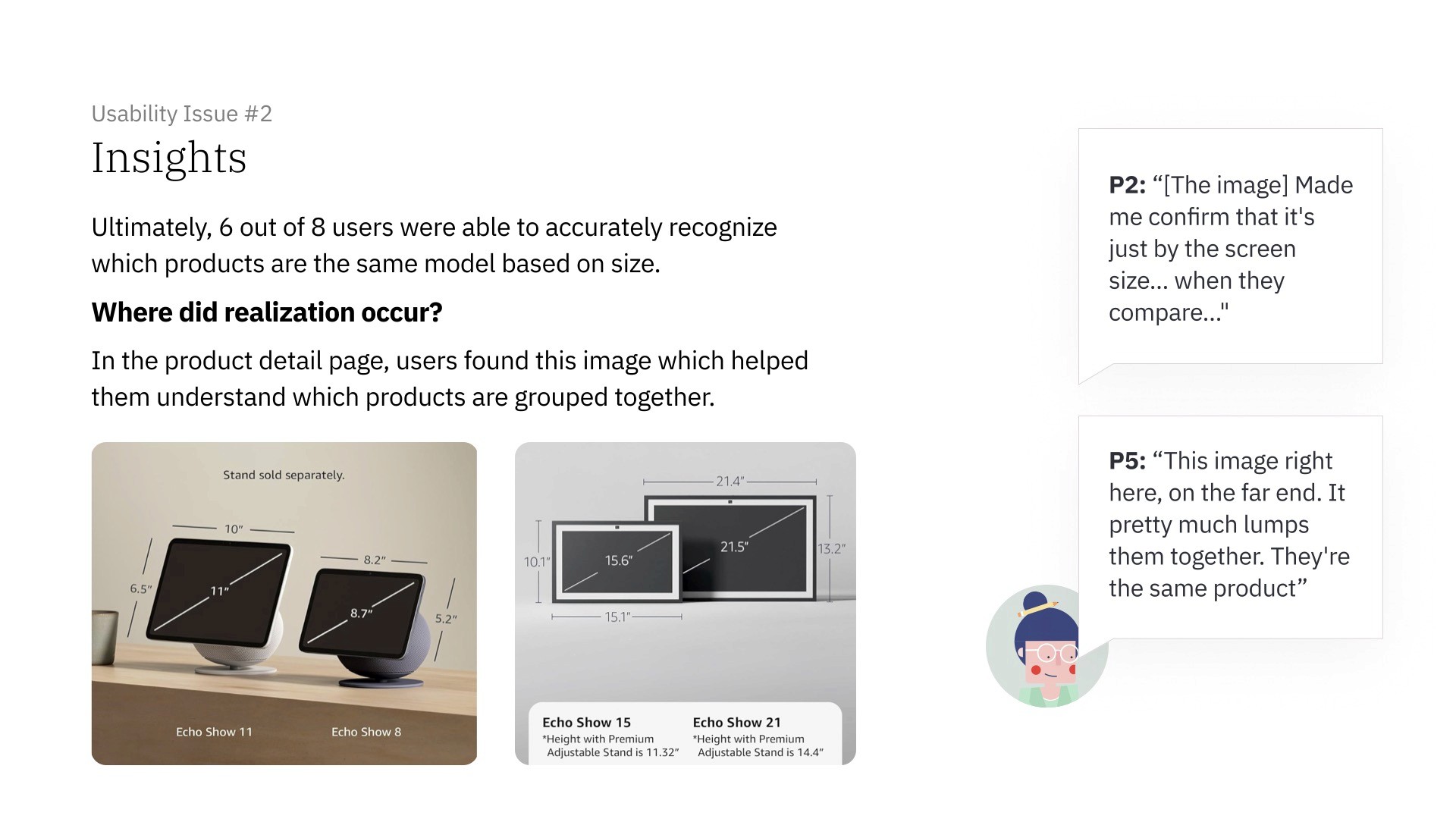
Usability Issue #2
Findings- RQ2
Alexa+ Discoverability
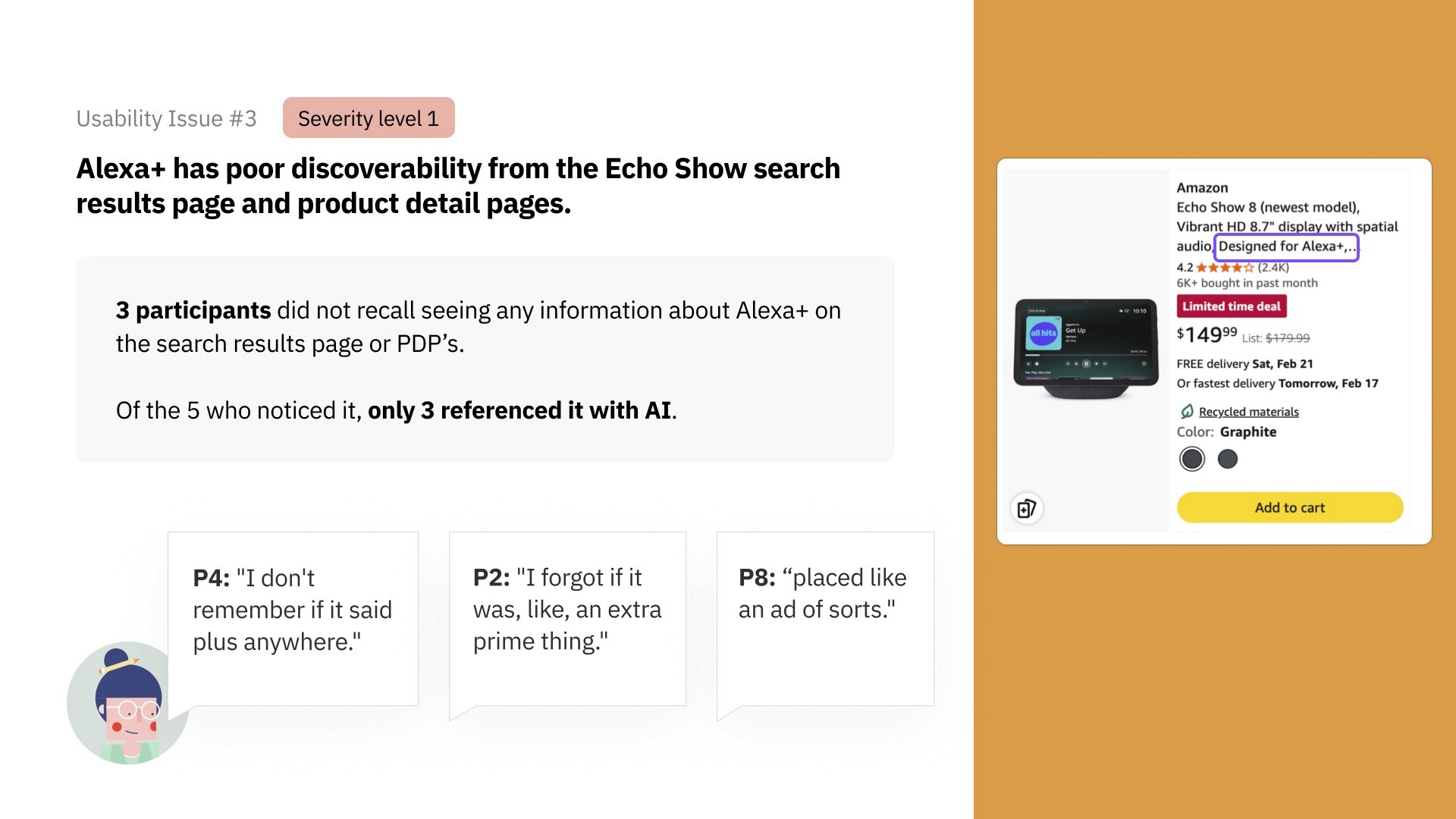
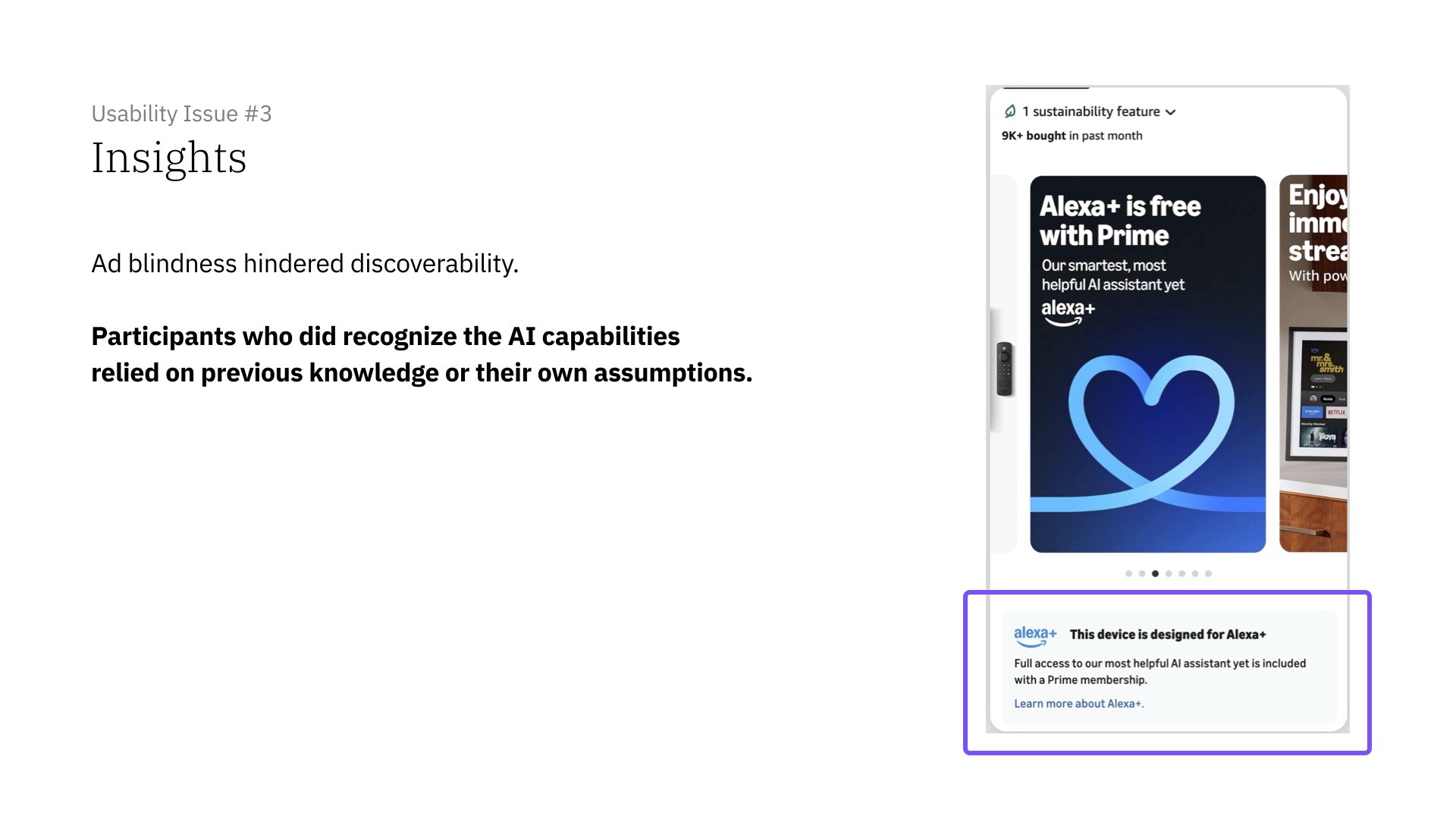
How effectively do users identify and understand Alexa+ as a feature of Echo Show devices
when viewing search results page elements, including images, titles, badges, and brief descriptions?
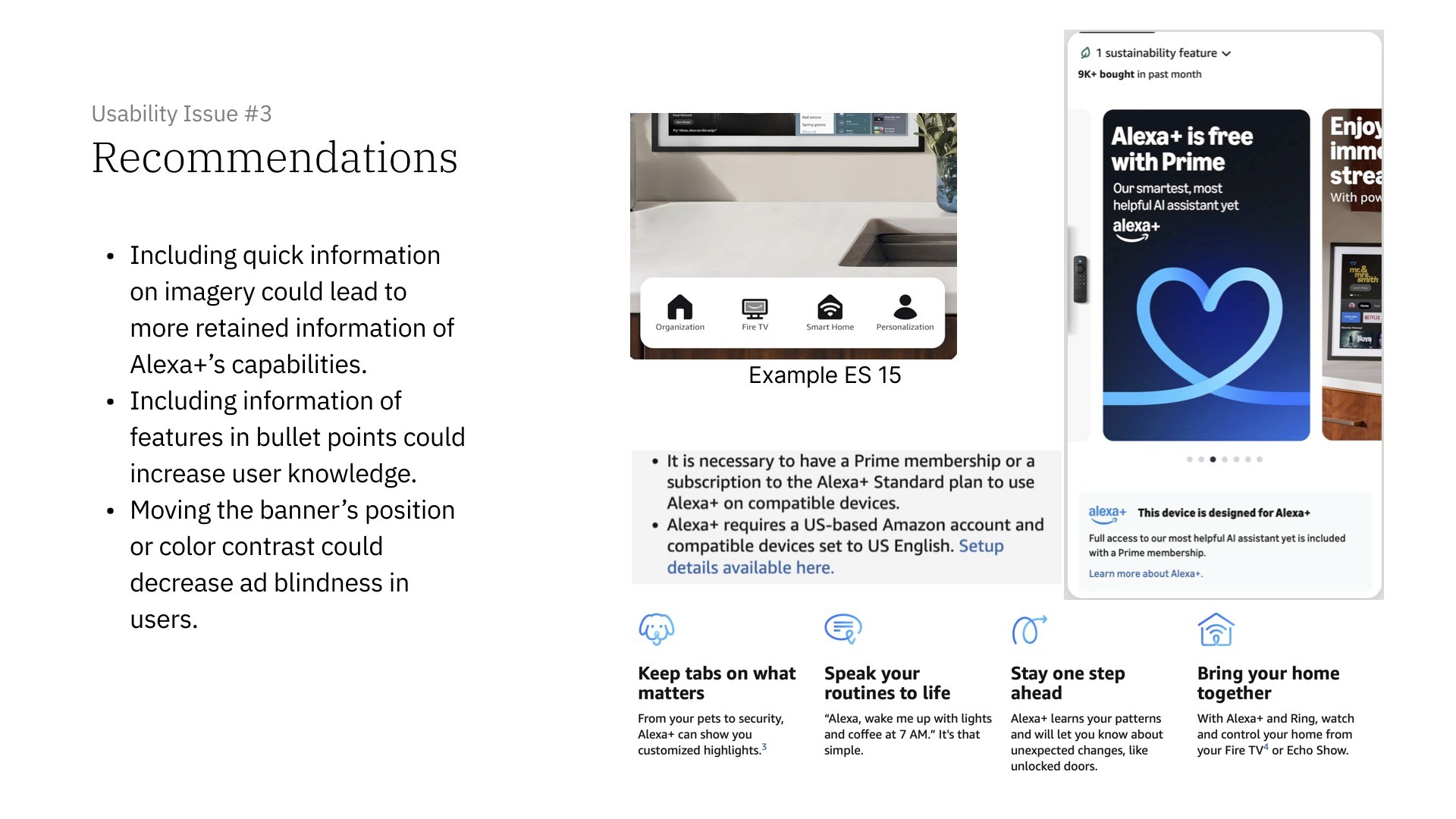
Usability Issue #3
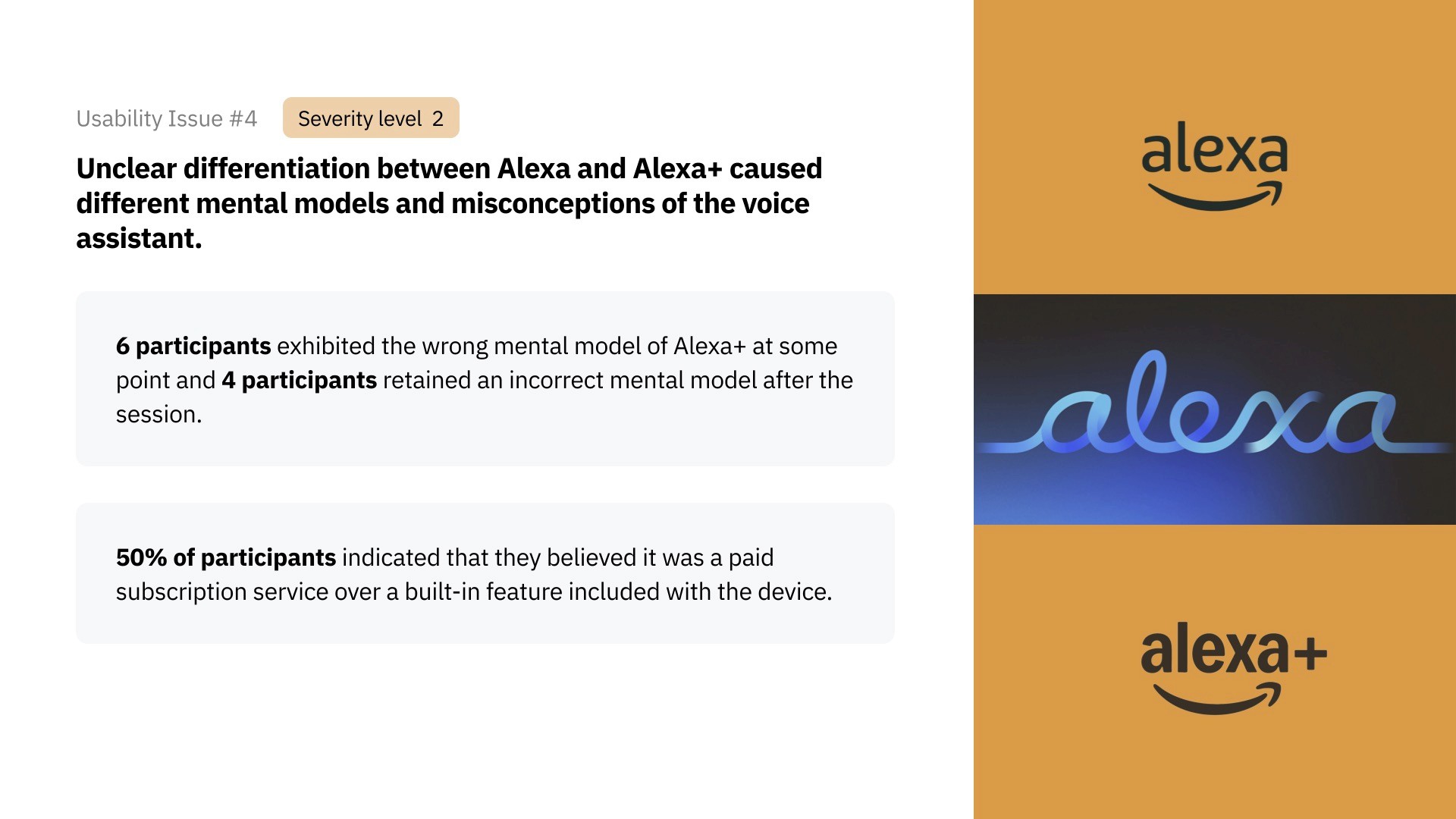
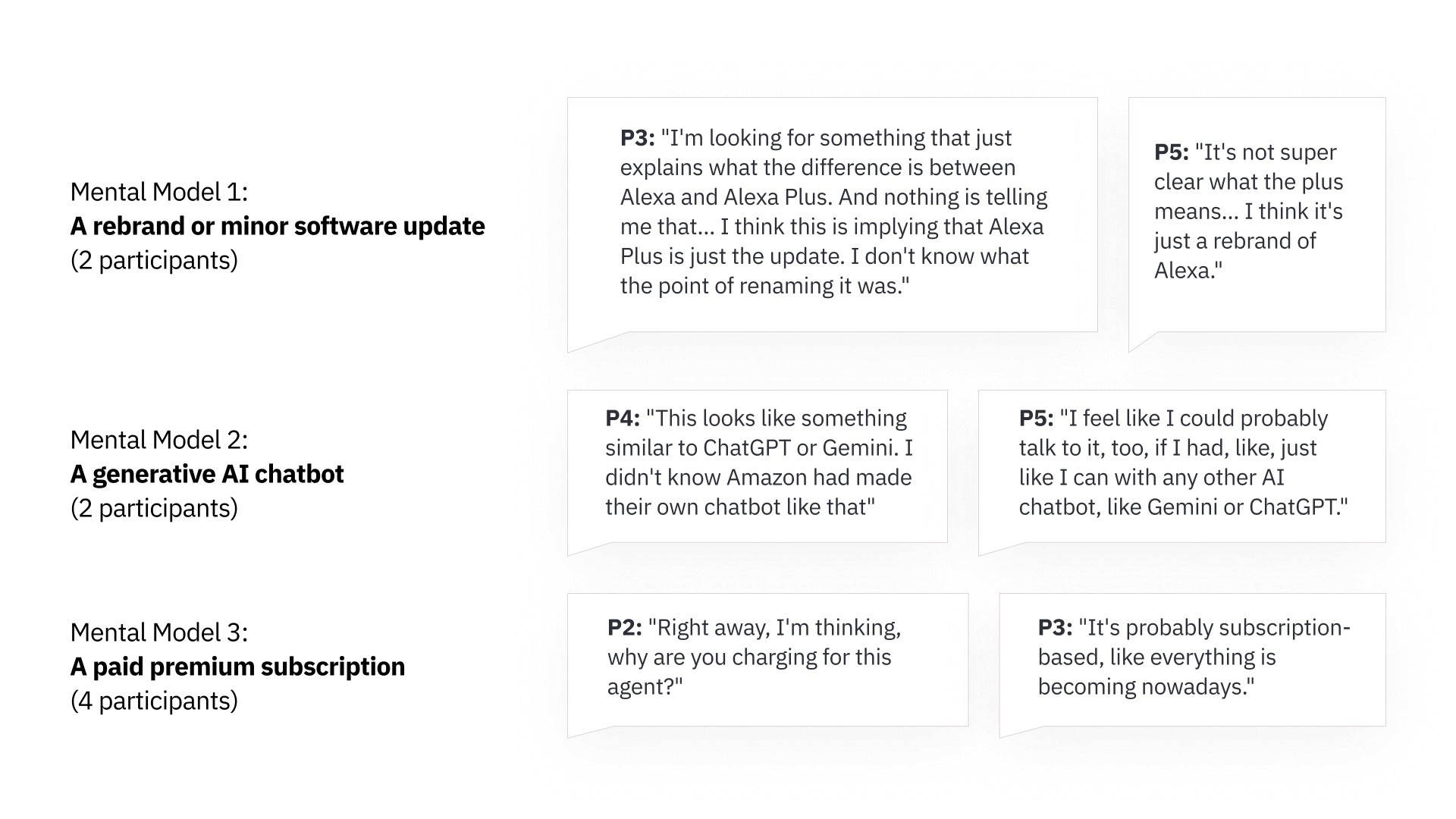
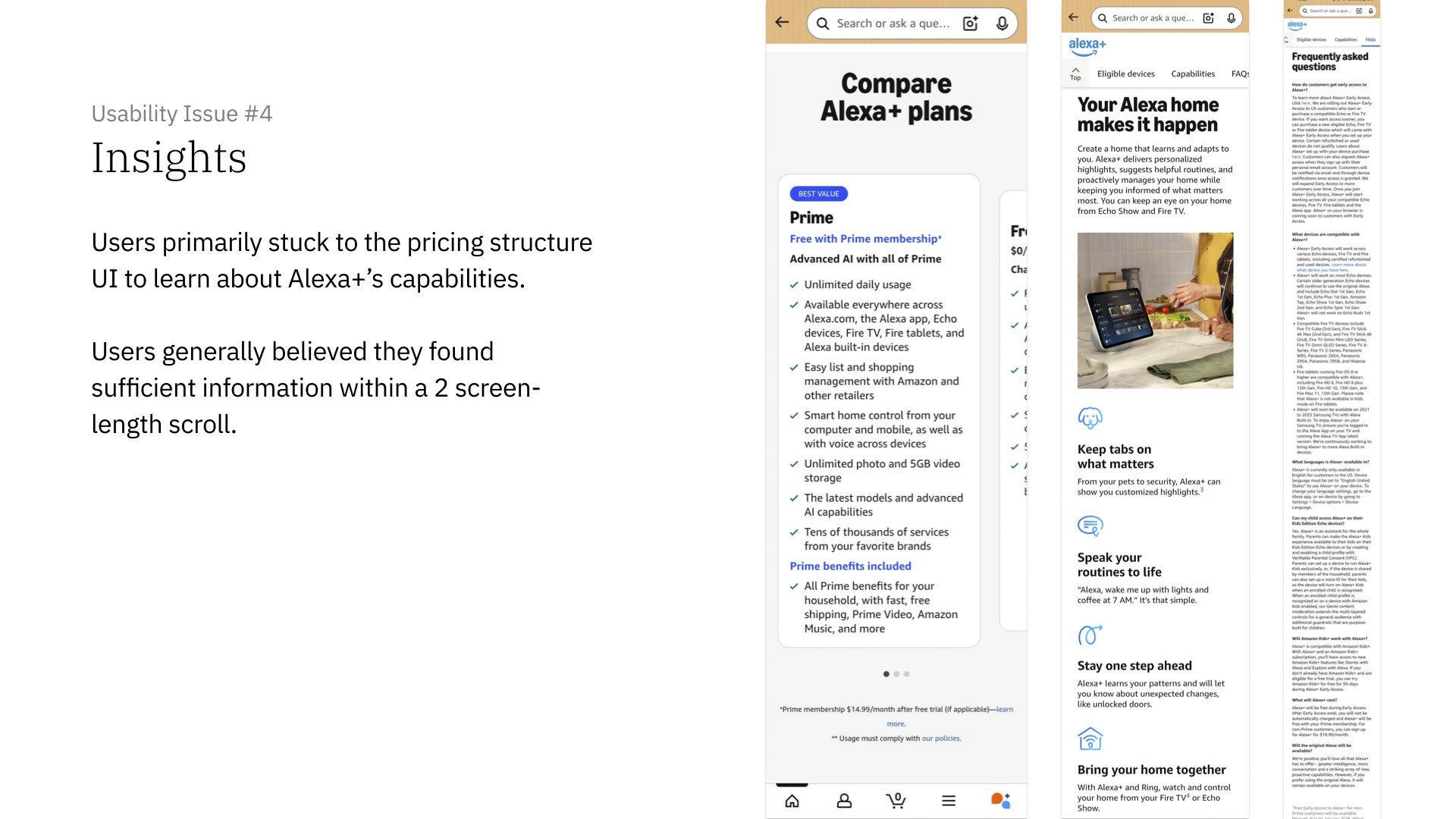
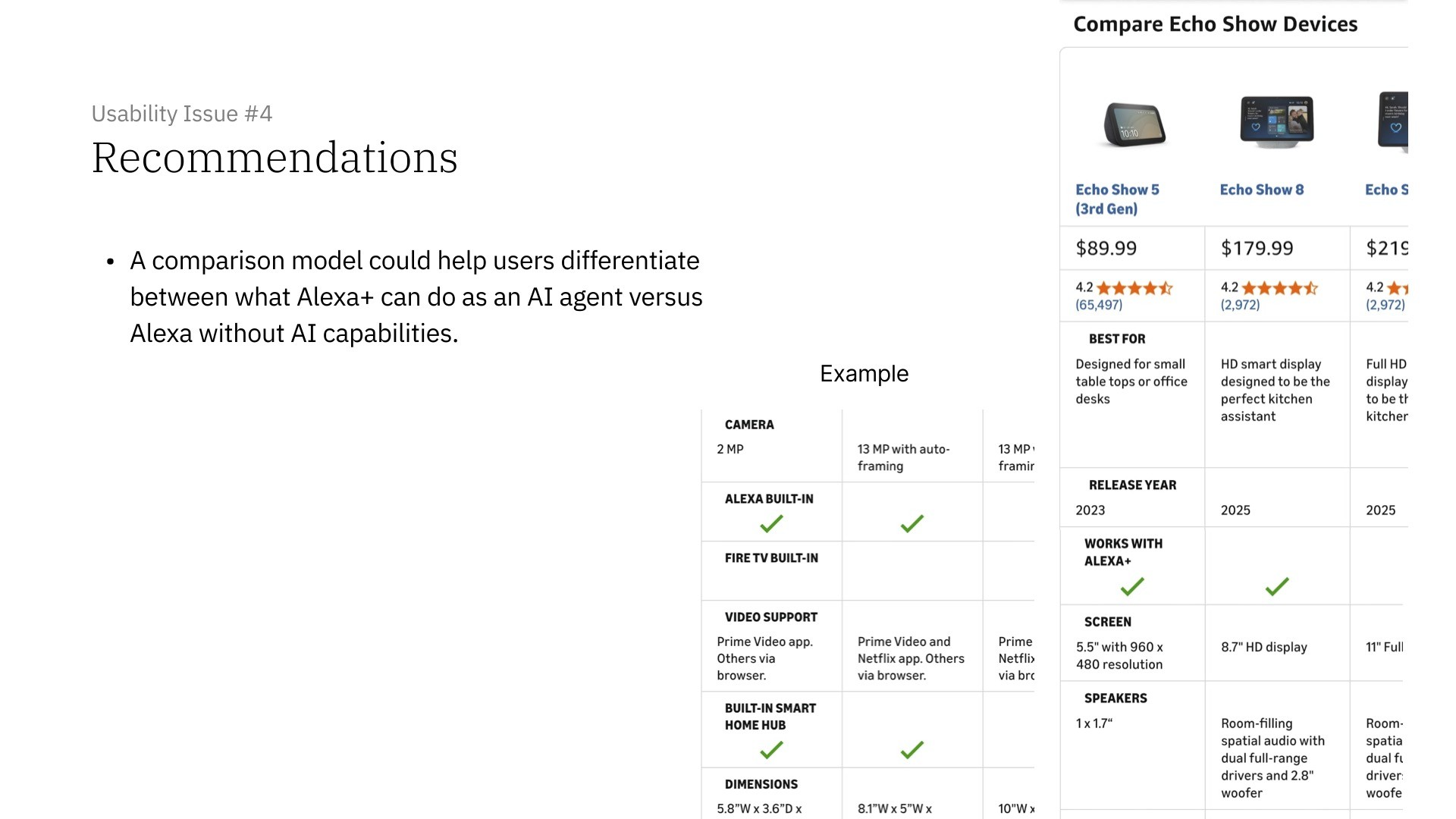
Usability Issue #4